
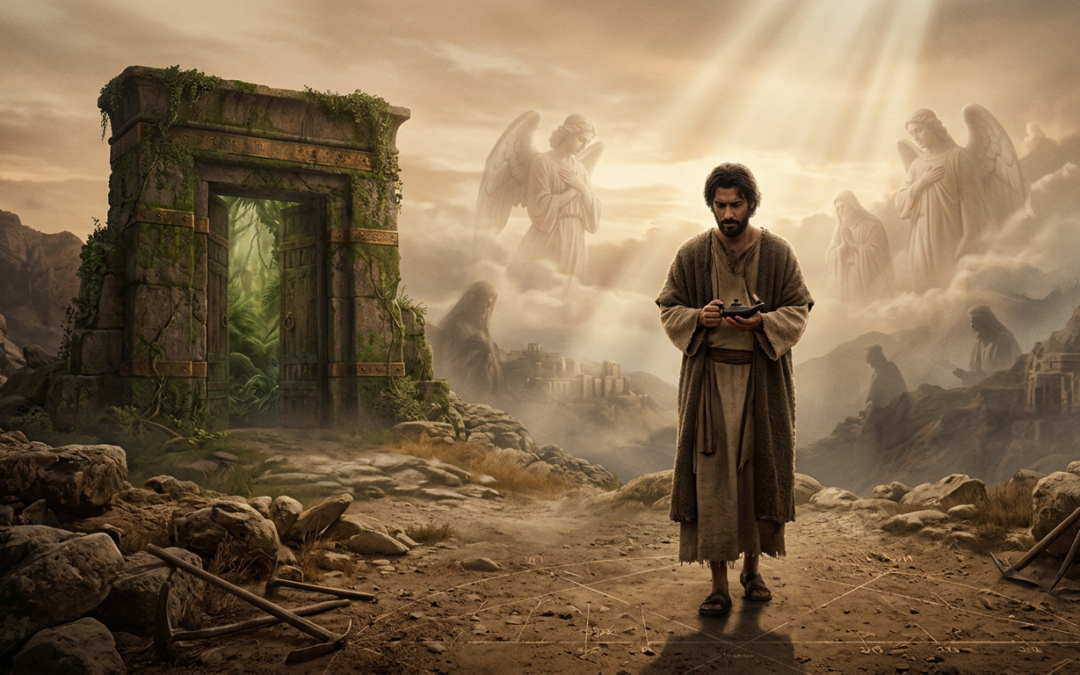
The invisible died before the visible decayed. That is one of the hidden horrors of Genesis 3. When Adam and Eve ate from the tree, they did not fall dead beneath its branches. Their bodies did not stop breathing, and their minds did not go blank. They could still think, choose, desire, feel, speak, and hide. The serpent had said, “You will not surely die,” and for a moment, it may have looked as if he had told the truth. But he had not. Something died in them before death appeared on them. Their visible bodies remained alive, but their invisible spirits went dark. Communion with God was broken at the root, and the inner place made for His presence became a shadowed sanctuary.
Genesis says, “Then the eyes of both were opened, and they knew that they were naked” (Genesis 3:7). That line sounds like the beginning of sight, but in truth it was the beginning of blindness. Their eyes opened to shame, but closed to glory. They saw their nakedness, but they no longer saw God as home. When they heard the sound of the LORD God walking in the garden, they hid themselves among the trees (Genesis 3:8). Before sin, the presence of God was their joy. After sin, His nearness felt like danger. The garden had not stopped being good, and God had not stopped being holy, but Adam and Eve had changed. The light inside them had gone out.
Before the fall, the world was filled with God’s nearness. Trees were not merely trees, fruit was not merely fruit, and wind was not merely wind. The garden was a sanctuary, and creation was alive with meaning. Adam and Eve could look at the visible world and receive it as a gift from the invisible God. They could walk with God because their spirits were alive to Him. There was no wall between the seen and the unseen, because there was no wall between their hearts and their Maker.
After sin, the same world became strange. The trees became a hiding place. The body became a source of shame. The voice of God became a sound to fear. This is why death is more than the grave. Physical death is terrible, but it is not the first death shown in Genesis 3. The first death is spiritual. It is the death of communion, the death of holy sight, and the death of the human spirit toward God. The body began its long return to dust, but the deeper tragedy had already happened. Man was still walking, thinking, building, loving, ruling, and dreaming, but now he was doing it east of Eden with darkened eyes.
Scripture describes this condition with sober clarity. Paul says fallen people are “darkened in their understanding” and “alienated from the life of God” because of the hardness of their hearts (Ephesians 4:18). That is Genesis 3 carried forward into the whole human race. Our problem is not simply that we lack information. Our problem is that we are cut off from life. The spirit was made to know God, enjoy God, and receive life from God. When that spirit dies toward Him, the mind may still be active, but it no longer sees reality as it truly is.
This is why the things of God often seem unreal to the natural person. Paul writes, “The natural person does not accept the things of the Spirit of God, for they are folly to him, and he is not able to understand them because they are spiritually discerned” (1 Corinthians 2:14). The issue is not intelligence. A person may be brilliant and still blind. He may study the stars, split atoms, build cities, write books, and explain the body down to its smallest parts, yet remain unable to see the kingdom of God. Spiritual truth must be spiritually seen, and a dead spirit cannot see what only the Spirit of God can reveal.
Materialism is one of the great monuments built by this blindness. It says matter is all there is. It teaches us to trust only what can be touched, measured, weighed, bought, sold, or controlled. It trains the modern mind to think of the visible world as the whole world. This sounds wise to many people today, but Scripture tells a different story. The visible world is real, but it is not all that is real. Paul says that in Christ “all things were created, in heaven and on earth, visible and invisible” (Colossians 1:16). Hebrews says that “what is seen was not made out of things that are visible” (Hebrews 11:3). The seen world came from the unseen word of God. Matter is not ultimate. God is.
This means materialism is not clear sight. It is the belief system of a race that has forgotten how to see. Modern man often thinks he has outgrown the invisible because he no longer believes in angels, demons, holiness, judgment, glory, or the kingdom of God. He imagines that disbelief is the same thing as maturity. But a blind man has not disproven the sun because he cannot see it. He has only revealed the darkness of his own eyes. The invisible realm did not vanish when Adam sinned. Humanity simply lost the ability to see it rightly.
That distinction matters because the unseen world is not empty, and it is not safe. Scripture does not present the invisible realm as a soft mist of spiritual feelings. It speaks of angels and demons, glory and darkness, thrones and powers, the Holy Spirit and deceiving spirits. Paul says, “We do not wrestle against flesh and blood,” but against spiritual powers and “the cosmic powers over this present darkness” (Ephesians 6:12). Fallen man is not living in a flat world of mere matter. He is living in a charged world filled with powers he cannot control and often cannot even recognize.
Because of this, any encounter with the invisible apart from God is dangerous. If God is not opening a person’s eyes and drawing him to Himself, then the darkness is more than willing to counterfeit light. The Bible warns that Satan blinds minds to keep people from seeing “the light of the gospel of the glory of Christ” (2 Corinthians 4:4). Evil does not always appear as evil. Deception often comes dressed as wisdom, freedom, power, or secret knowledge. This is why man cannot safely wander into the unseen on his own. The dead spirit cannot master the invisible. It cannot even interpret the invisible rightly without grace.
This also helps explain why the gospel must be more than advice. If our deepest problem were poor behavior, we would only need better rules. If our deepest problem were ignorance, we would only need better teaching. If our deepest problem were weakness, we would only need more strength. But if our spirit is dead toward God, then we need life. We do not merely need to be corrected. We need to be raised. We do not merely need to be told where to look. We need new eyes.
Jesus made this clear when He spoke to Nicodemus. He said, “Unless one is born again he cannot see the kingdom of God” (John 3:3). Notice that Jesus said a person cannot see the kingdom unless he is born again. The kingdom is not imaginary before the new birth, but it remains unseen. The problem is not that God’s reign is absent. The problem is that fallen man does not have eyes for it. Regeneration is not a religious upgrade to an already healthy life. It is the Spirit of God bringing life to the dead spirit and opening the eyes of the heart.
Paul prays this way for believers when he asks that God would have “the eyes of your hearts enlightened” so they may know the hope to which He has called them (Ephesians 1:18). That phrase is beautiful because it tells us that the heart has eyes, and those eyes need light. When the Holy Spirit gives life, the inner lamp begins to burn again. A believer does not suddenly see everything perfectly, but he begins to see truly. Christ becomes beautiful. Sin becomes bitter. Scripture becomes alive. Creation becomes charged with meaning. The visible world becomes a window again instead of a wall.
This is the heart of True Fantasy. True Fantasy is not an escape from reality. It is the recovery of reality. It teaches us to see that the world is deeper than its surfaces. Bread can be more than bread, water can be more than water, and a tree can be more than wood and leaves. Stones can cry out, angels can appear as strangers, a garden can be a sanctuary, a cross can be a throne, and a tomb can become the doorway of resurrection. The materialist world is too small for Scripture because it has no room for burning bushes, flaming swords, opened heavens, heavenly councils, or the Spirit hovering over the waters. It has no room for glory.
Genesis 3 tells us why we stopped seeing. The invisible died before the visible decayed. Communion with God was broken, and the eyes of the heart went dark. Since then, humanity has been trying to live in a haunted world while pretending there are no spirits, no glory, no judgment, and no God behind the veil. We have filled the world with noise, machines, screens, and explanations, yet still we ache for wonder because we were made for more than matter.
The hope of the gospel is that God has not left us blind. He speaks into the darkness. He reveals what we could never discover on our own. He sends His Spirit to raise the dead from the inside out. The same voice that called, “Where are you?” in the garden still calls sinners out of hiding. The same God who guarded Eden’s gate has opened the way to life through Christ.