
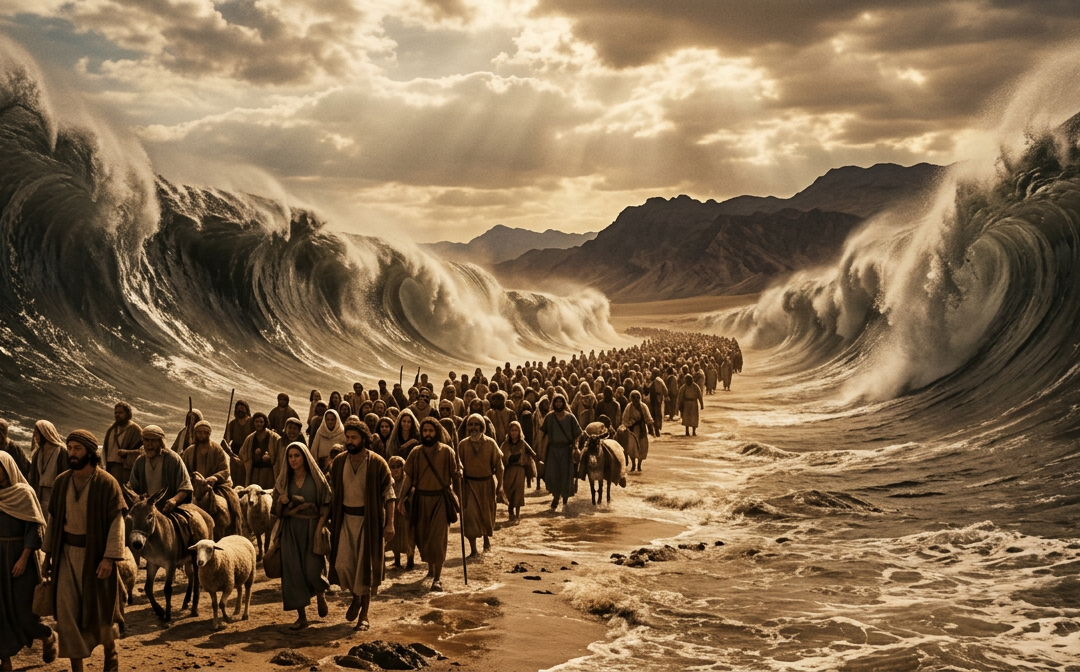
Whenever floodwaters rise, we remember that water is not always peaceful. It can be beautiful in a glass, calming beside a shore, and life-giving in a field, but when it breaks its boundaries, it becomes terrifying. It can sweep away roads, homes, plans, and lives in a matter of moments. In those moments, we are reminded that the world is not as manageable as we pretend, and that chaos is never as far away as we think.
Most of us know what it feels like to stop at the water’s edge. We know how to measure the danger in front of us and name the fear behind us. Israel knew this feeling well. In Exodus 14, Pharaoh’s army was coming from behind, and the Red Sea stretched out before them. There was no bridge, no boat, no military plan, and no visible way forward. To human eyes, the story was over.
Water in the ancient world often pictured chaos, danger, and death. The sea was not calm background scenery. It was a threat. So when God parted the waters, He did more than provide an escape route. He showed His power over chaos itself. The Invisible God made Himself visible by tearing open what no human hand could move. Israel did not simply receive guidance. They saw the Lord rule creation.
At the Red Sea, Egypt and Israel faced the same waters, but not from the same place. Israel stood there as a rescued people, weak and afraid but held by the Lord’s covenant mercy. Egypt charged forward in hardened rebellion. For one, the sea became a road of deliverance. For the other, it became the place of judgment.
To the modern skeptic, the Red Sea may sound impossible. But that is precisely the point. Exodus 14 is not presented as a metaphor for positive thinking or inner strength. It is presented as an act of God in history. If the event feels impossible to us, Exodus would answer: exactly. The sea opens because the Lord of creation stands before it.
But this is not only an atheist or agnostic problem. Even Christians with strong doctrine can live as if the supernatural is embarrassing. We may affirm miracles on paper while quietly explaining them away, avoiding them, or treating them as strange parts of the Bible that do not shape our daily lives. We believe God is sovereign, yet when chaos rises, fear often becomes our interpreter. We see the sea more clearly than we see the Lord.
The Red Sea teaches us to trust God in impossible moments. Yet faith must also ask another question: What happens when God does not part the sea? Sometimes He opens the way. Sometimes He strengthens us to stand. Sometimes He carries us through suffering rather than around it. The point is not that every crisis ends the way we hoped. The point is that chaos is never ultimate. The visible threat is never the deepest truth.
Job learned this when God spoke from the whirlwind. The Lord reminded him that He set boundaries for the sea and said, “Thus far shall you come, and no farther” (Job 38:11). In other words, God’s rule over the waters was not only displayed at the Red Sea. It is displayed every day. Every wave that rises and falls, every shore that holds, every chaos that does not consume the world bears witness to the unseen command of God.
At the Red Sea, God revealed that His people live in a world ruled by His unseen hand. The waters obeyed Him. The enemy could not overcome Him. Fear did not have the final word. And when we reach our own water’s edge, we are invited to see what Israel saw: the Invisible One is still Lord over every chaos we face.