
Genesis 1 and 2 opened like sunrise. Light broke into darkness at God’s command, and the world took shape under His voice. The heavens stretched wide. The seas gathered into their places. The land rose, bloomed, and filled with life. Humanity stood upright in a garden that was more than soil and trees. It was a sanctuary, a holy place where God walked with His people. His presence was not far away or hidden. The world was not divided into sacred and ordinary places, because everything breathed with order, harmony, and purpose.
Then Genesis 3 fractured that world.
The serpent’s whisper did more than tempt Adam and Eve. It twisted their trust in God and turned their hearts inward. The first rebellion was not loud, and it did not look like war. It looked like fruit lifted to the mouth. Yet in that quiet act, something terrible happened. The image-bearers of God chose independence over closeness with Him. They reached for wisdom apart from the One who is Wisdom. They wanted to rule without remaining under His rule.
Then the ground shifted beneath them. Shame entered where there had once been openness. Fear entered where there had once been delight. Blame entered where there had once been unity. Even the air seemed heavier. The soil that had once yielded freely would now resist human hands. The body that had once known only life would now bend toward death.
Genesis 3 is not simply the story of a mistake. It is the story of a rupture. That rupture is spiritual, but it does not stay hidden. It moves outward like cracks spreading through stone. It reaches into marriage, work, childbirth, and even the ground itself. Creation groans under the weight of a decision made by those who were meant to guard it. The harmony of Genesis 1 and 2 does not disappear, but it is wounded. What was once effortless becomes strained, and what was once united becomes divided.
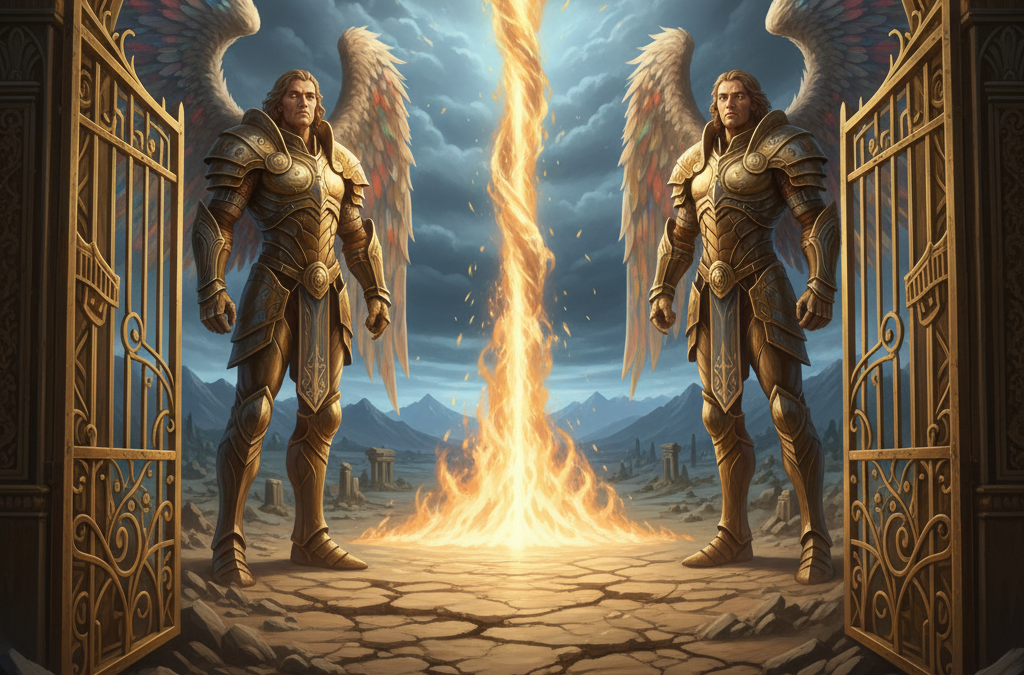
Then the gates close. The cherubim stand with wings and flame, and the way to the Tree of Life is guarded. Humanity steps east of Eden, while the garden fades behind them. Exile begins.
It is easy to see exile only as punishment, but Scripture hints that it is also mercy. The sword does not destroy the tree. It protects it. Eternal life in a fallen state would not be salvation. It would be endless corruption. So God drives humanity out, not because He has stopped caring, but because holiness must restrain what sin would ruin forever.
Still, mercy can feel like loss. East of Eden, the ground is harder and the sky seems farther away. The voice that once walked in the garden in the cool of the day is no longer heard in the same way. Humanity carries memory like an ache. We remember something we cannot return to, and we long for something we cannot reclaim.
The fracture does not remain small. When the human heart turns inward, it does not stay contained. Sin is never still. It grows. What began as distrust becomes rivalry. What began as blame becomes violence. What began as hiding becomes defiance. The image-bearer who was meant to reflect God’s character begins to reflect something else: envy, domination, and pride.
East of Eden, humanity learns to build. We build cities, tools, and culture. These things are not evil in themselves, but when they are built from fractured hearts, they bend out of shape. Instead of ruling creation in harmony, we begin to rule one another through control. Strength becomes a weapon. Power becomes a throne we seize instead of a stewardship we receive. The earth, which was given to be cultivated, becomes a stage for human ambition.
The serpent’s voice does not vanish at the garden gate. Its influence lingers and keeps whispering that autonomy is freedom and that God’s boundaries are chains. Darkness gathers at the edges of the story, and other unseen forces move in the shadows for a time, stirring corruption and chaos. The world that once felt clear with God’s presence begins to feel crowded with something else.
The tragedy of Genesis 3 is not only that humanity was expelled from the garden. It is that humanity begins to lose sight of God. When we turn inward long enough, we forget what His nearness felt like. We reshape reality around ourselves. We measure good and evil by advantage instead of obedience. We begin to believe that we can define life on our own terms. The farther east we move, the easier it becomes to imagine that Eden was only a story and that the flaming sword was only a symbol.
But the sword was real. The cherubim were real. The fracture was real. The consequences will be real too.
Genesis 4 through 11 will not read like a gentle unfolding of history. They will read like a warning. They will show what happens when human hearts multiply without repentance. They will show how quickly violence grows, how easily pride builds systems, and how rapidly corruption spreads when it is not restrained. They will show a world that still bears God’s image, but twists it until it is almost unrecognizable.
It is terrifying to see what humanity can become without God. Yet even in the shadow, a thin thread of mercy runs through the story. God does not withdraw completely. He speaks, marks, restrains, and judges, but He also preserves. Even east of Eden, He remains active. The same God who stationed the cherubim still watches. The same voice that spoke light into darkness has not gone silent. Holiness has drawn a boundary, but it has not abandoned history.
Exile is not the end of the story. It is the beginning of a different kind of story.
Genesis 1 and 2 revealed a world where God was visibly near. Genesis 3 revealed what happens when that nearness is rejected. What comes next will reveal something else: how God makes Himself known to a fallen people who have forgotten Him.
He will not always do it gently. He will reveal Himself through judgment and mercy, through power and restraint, and through acts that shake the earth and humble the proud. He will show who He is by confronting what we have become. He will press His presence into a world that no longer seeks Him, not because He delights in force, but because love that refuses to confront evil is not love at all.
East of Eden, the fracture widens. The human heart drifts farther from God. The world grows louder, darker, and more restless. But the guarded garden still stands behind the flame. The Tree of Life still lives. The God who closed the gate has not closed His purposes.
The story moves forward, and it does not grow safer. It grows deeper.