
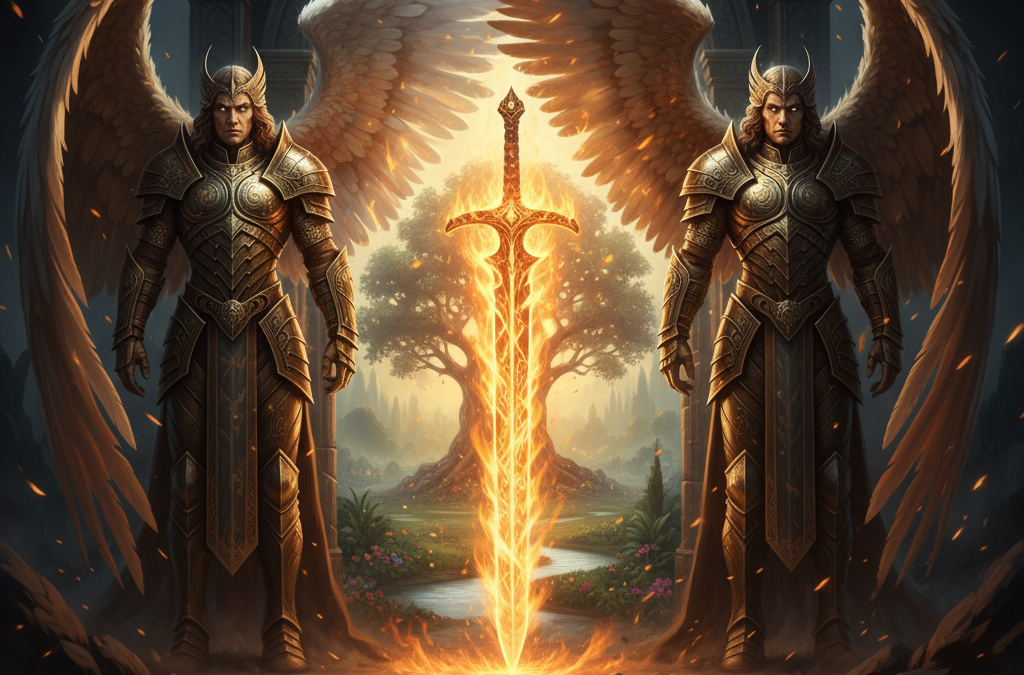
Genesis 3:24 does not end quietly. It ends with wings and flame: “He placed the cherubim and a flaming sword that turned every way to guard the way to the tree of life.”
If the verses before this felt like the shutting of a great door, this verse shows us what stands on the other side. It is not emptiness or silence. It is not a forgotten garden left to decay. It is guarded glory. What guards it is unlike anything we have seen so far in Scripture. Here we meet the first cherubim, the first weapon, and the first fire on earth. At this point, True Fantasy does not shrink back. It rises.
The cherubim appear suddenly, without much explanation, as though Moses expects us to feel the weight of what he is describing. This is their first entrance into the biblical story. There is no genealogy, no long introduction, and no detailed description. There is only their presence at the edge of Eden.
Later Scripture fills in what Genesis leaves only suggested. In Ezekiel 1 and 10, cherubim appear as living creatures of terrifying beauty. They are radiant with glory, move like flashes of lightning, have wings, and are connected with the throne of God. In 1 Samuel 4:4, the Lord is described as being “enthroned on the cherubim.” In Psalm 18:10, He rides upon a cherub and flies. When the tabernacle is built, golden cherubim stretch their wings over the mercy seat, the place where atonement blood will later be sprinkled (Exodus 25:18–20).
Wherever cherubim appear, they mark the boundary of holiness. They are not simply messengers like many angels. They are guardians of glory. They stand where heaven touches earth, and their presence does not soften the scene. It makes the scene more serious.
Their first appearance is not a celebration. It is judgment, and that tells us something important. God does not retreat from the world after sin enters it. He does not step back in wounded surprise. Instead, He stations His throne guardians at the edge of Eden and marks the boundary Himself. This is not abandonment. It is enforcement.
The garden was never only a beautiful park. It was a sanctuary. Adam was never merely a gardener. He was a priest-king, called to work and keep sacred space. When he failed, the sanctuary did not vanish. It became restricted. The cherubim declare that God’s presence remains real, radiant, and dangerous to the unholy.
Modern people often feel embarrassed by beings like this. Wings, glory, and flashing forms can sound too strange or too otherworldly for a world that many people imagine as flat and closed. We often prefer metaphors over messengers and symbols over real spiritual beings. But Scripture does not apologize for the supernatural. It reveals it. If God is truly holy, then holiness must have guardians. If God truly dwells with His creation, then His dwelling must have a threshold. The cherubim are not decorative fantasy. They are necessary in a world charged with moral meaning.
Then comes the sword. It is not in the hand of man, and it is not forged in human fear. It is placed by God. This is the first weapon in the Bible. Before Cain raises his hand against Abel, before nations gather armies, and before kings wield steel, there is already a sword, and it belongs to God.
That matters because we often think of violence only as something that comes from human sin. Much of it does. Yet Genesis 3:24 shows us something deeper. There is such a thing as holy force. There is a kind of power that does not come from rage, envy, or fear, but from justice.
The sword is not dull or ceremonial. It is flaming and turns every way. The picture is of a flashing, whirling blade, like lightning in motion. No one can slip past it from the left or the right. No one can time its movement or predict a safe opening. It guards “the way to the tree of life.”
This is holiness armed for judgment. It is not excessive or reckless. It is measured. The sword does not sweep across the earth in blind anger. It does not chase Adam into the fields. It stands at the boundary and enforces what God has already spoken: sin brings separation.
This image can make us uncomfortable. We may shrink from the thought of God placing a weapon at the entrance to Eden. We often prefer to think of Him only as gentle, patient, and affirming. We imagine that love and force cannot exist together. Yet even in our broken world, we know that some things must be restrained. A surgeon cuts in order to remove cancer. A judge gives a sentence to protect the innocent. A father steps between danger and his child. If sin is not a small thing, then God’s opposition to sin cannot be small either.
The flaming sword tells us that evil is not a minor flaw in an otherwise harmless story. It is a rupture that calls for a serious response. God is not passive toward what destroys His creation. He is not indifferent toward what corrupts His image-bearers. He is patient and merciful, but He is not passive. The sword stands as a declaration that holiness defends what is holy.
Until this moment, fire has not appeared in the biblical story. Eden required no flame. There was no cold to warm, no raw meat to cook, and no impurity to burn away. Creation was ordered, life-giving, and declared very good. Fire enters only after exile, and it enters not first as comfort, but as a boundary. The sword is flaming.
This is not an accidental detail. In Scripture, fire is never empty decoration. It consumes, purifies, judges, and reveals. It is the element of irreversible change. When something passes through fire, it does not return the same.
Here at the gate of Eden, fire becomes the visible sign that access to eternal life is not casual. The Tree of Life cannot be taken by stealth. Immortality cannot be seized by rebellion. The way is guarded by flame.
Even so, the fire is restrained. It is local. It serves a purpose. The sword does not destroy the tree. It protects it. Fire becomes the barrier that preserves hope until the right time. This matters for how we see the world. Fire is not ultimate. It is an instrument. The cherubim do not act on their own authority. They are placed there. The sword does not whirl at random. It guards. God stands above the flame.
Later in Scripture, fire will fall in judgment, rest as a sign of God’s presence, and refine what is impure. But here, at the beginning, fire marks the seriousness of sin and the sacredness of life. It shows that something irreversible has happened and that restoration will not be cheap.
We should also notice carefully what the text says. The cherubim and the flaming sword guard “the way to the tree of life.” The way still exists. It is not erased or destroyed. It is guarded, and that detail changes everything.
If the tree had been uprooted, hope would be gone. If the path had vanished, redemption would be impossible. But a guarded way suggests future access under the right conditions. The sword does not announce the end of the story. It announces the cost of re-entry.
Throughout Scripture, the language of “the way” will continue to echo. There is the way of righteousness, the way of holiness, and the narrow way that leads to life. The guarded path in Genesis becomes a thread that runs through the whole biblical story.
True Fantasy shines here because the scene is clearly wondrous. There are winged guardians and whirling fire, yet these images are not used for escape. They reveal the hidden structure of reality. The universe is not morally neutral. There is a path to life, and it is guarded by holiness. Access requires transformation, not defiance. The sword stands between corruption and immortality, and that is mercy.
When Israel later builds the tabernacle, cherubim are woven into the veil that separates the Holy of Holies (Exodus 26:31). They are also shaped above the mercy seat, where blood is sprinkled once a year. Every time a priest enters that sacred space, he is symbolically passing the guardians of Eden.
The message is clear. Access to God’s presence requires mediation. The cherubim at Eden were not a passing detail. They were the first unveiling of a pattern that would shape worship, sacrifice, and longing for generations.
Ezekiel later sees the glory of the Lord departing from the temple, carried by cherubim (Ezekiel 10). The throne is mobile. Holiness is active. The guardians remain. Yet hope remains too. The same beings who guard also carry. The same fire that destroys also refines. The same God who stations the sword also makes garments, speaks promise, and keeps history moving toward redemption.
Genesis 3:24 shatters sentimental spirituality. God is not a vague force of encouragement. He is the enthroned King whose holiness burns with flame. Sin is not a minor mistake. It is treason that requires guarded boundaries. Eternal life is not a human possession. It is a divine gift, protected until the appointed time.
This changes how we see everything. It helps us understand why worship in Scripture is careful and reverent, why sacrifice is costly, why prophets tremble, and why mountains burn when God descends. The world is not spiritually dull. It is alive with holiness, judgment, mercy, and glory.
The cherubim and the flaming sword teach us that love without holiness is not biblical love, and mercy without justice is not biblical mercy. The God of Scripture is not embarrassed by His own glory, and we should not be embarrassed by it either.
True Fantasy invites us to lift our eyes and see that the world is more charged than we often think. There are guardians at the gates of glory. There is fire at the edge of immortality. There is a throne above it all.
Yet the way remains. It is guarded and, for now, closed, but it’s not gone. The sword does not swing wildly through history. It stands where it must. The cherubim do not erase hope. They protect it. The fire does not rule. It serves.
And in the distance, beyond wings and flame, the Tree of Life still stands.