
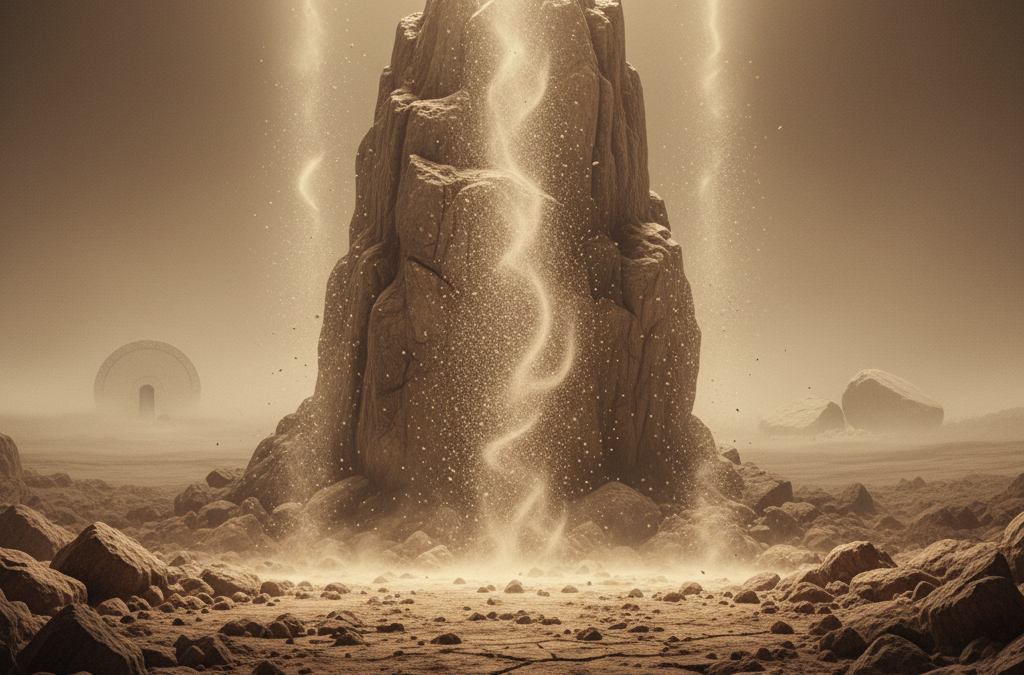
Before there were cities, temples, crowns, swords, or stories of kings, there was soil.
On the third day of creation, God spoke, and dry land appeared. Genesis 1:9 tells us that the ground rose from beneath the waters, not because of accident or chance, but because God commanded it. He called it forth, named it, and declared it good. The earth was not an afterthought in His design. From the beginning, it was shaped with care and given purpose.
Then something even more personal happened. Genesis 2:7 says, “The LORD God formed the man from the dust of the ground and breathed into his nostrils the breath of life.” The Hebrew words are closely connected: Adam from the adamah—the man from the soil. Humanity was formed from dirt.
Not from light, fire, precious metals, or shining stone. From dust.
That truth is deeply humbling. Dust gathers in corners and settles on shelves. We wipe it away without thinking. It drifts on the wind and disappears into the air. Yet God bent low, so to speak, and shaped that dust with care. Our value does not come from the material itself, but from the breath God gave it. Dust plus divine breath became a living soul.
This tells us something important about God’s relationship with dirt. He is not ashamed of it. He does not avoid it. He works with it, forms with it, and breathes life into it. Even after sin enters the world, God does not abandon the ground He made.
When Adam sins, the curse touches the soil. In Genesis 3:17, God tells Adam that the ground is cursed because of him. Thorns and thistles begin to grow where fruit once flourished, and the earth resists the hands that once tended it with ease. Humanity and the ground are now bound together in both blessing and burden. Then God says, “For dust you are, and to dust you shall return” (Genesis 3:19).
Dust becomes a sign of mortality. It reminds us that we are formed and finite, dependent and fragile. The very material from which we were shaped now reminds us that we cannot sustain ourselves. Yet the ground itself does not become evil. It becomes wounded. It groans under the weight of sin.
Paul writes in Romans 8:22 that “the whole creation has been groaning as in the pains of childbirth.” The earth is not silent in its suffering. It aches, waits, and longs for restoration alongside humanity. In many ancient myths and religious systems, physical matter is seen as lower, corrupt, or something to escape. Dirt is treated as inferior, while spirit alone is considered pure. But Scripture tells a different story. In the Bible, dirt is not the problem. Sin is. The Creator does not discard the ground. He promises to renew it.
As the story of Scripture unfolds, stone also begins to carry deep meaning. When Israel is thirsty in the wilderness, God tells Moses to strike the rock, and water flows out for the people. Later, Moses speaks to the rock, and again water pours forth. In a dry and barren place, life comes from stone. Paul looks back on this moment in 1 Corinthians 10:4 and writes, “They drank from the spiritual Rock that accompanied them, and that Rock was Christ.”
The rock in the desert was not merely a piece of geology. It was a sign. Stone became provision. Hardness gave way to living water. The ground that once bore thorns became a source of life. God does not simply use dirt and rock. He fills them with purpose and meaning that point beyond themselves.
Throughout the Old Testament, God Himself is called a Rock. Psalm 18:2 says, “The LORD is my rock and my fortress.” Psalm 62:2 says, “He alone is my rock and my salvation.” A rock stands firm when storms come. It does not shift with fear, emotion, or opinion. It remains steady when everything around it trembles.
When Jesus speaks of the wise man building his house on the rock in Matthew 7:24–25, He is describing a life founded on obedience to His words. The rain falls, the floods rise, and the winds beat against the house, but it does not fall because it rests on something solid. Later, when Jesus says, “On this rock I will build my church” (Matthew 16:18), He is not speaking of something fragile or temporary. He is speaking of a foundation that cannot crumble, a bedrock strong enough to hold the weight of redemption. The Church is not built on shifting sand, nor on anything less than Christ Himself.
Stone in Scripture becomes a symbol of permanence in a world marked by decay. That meaning grows even deeper at the tomb of Jesus. After He is crucified, His body is placed in a tomb carved from stone, and a great rock is rolled in front of the entrance. The earth receives Him. The same kind of material from which Adam was formed now holds the body of the Second Adam in death.
But on the third day, the stone is rolled away.
Rock cannot imprison Him. The grave cannot hold the One who formed the dust in the beginning. The ground that once received Abel’s blood now witnesses resurrection life. The stone becomes not a barrier, but a testimony. The earth that groaned begins to tremble with hope.
On the road into Jerusalem, as the crowds praise Jesus, some Pharisees tell Him to silence them. Jesus answers, “If they keep quiet, the stones will cry out” (Luke 19:40). Creation is not indifferent to its Maker. If human voices fall silent, the rocks themselves will speak. The soil that felt His forming hands, the stone that held His body, and the dust that received His blood all belong to Him.
Psalm 19 says, “The heavens declare the glory of God.” The skies speak, the mountains respond, and the fields bear witness. Creation is not just scenery for the human story. It is a choir joining in praise.
In our own time, many people have become fascinated again with dirt and stone. Crystals are collected, displayed, worn around necks, and placed beside beds. They are given meanings such as protection, healing, alignment, energy, and awakening. The earth is treated not merely as material, but as mystical. There is an instinct that something more is present within creation.
That instinct is not entirely wrong. There is something in the dirt. There is something in the stone. Creation does hum with meaning. It is not empty or accidental. It carries the fingerprints of its Maker. Scripture says the heavens declare the glory of God, and Romans 1:20 says that God’s invisible qualities are clearly seen in what He has made.
The problem is not that people sense meaning in creation. The problem is where they stop.
Crystals cannot heal a soul. Stones cannot forgive sin. Soil cannot speak the final truth. They are signs, but signs are not destinations. A road sign pointing to a city is helpful only if you follow it. If you cling to the sign and never enter the city, you miss the point.
The New Age movement often recognizes that the material world is full of meaning, but it separates that meaning from the personal Creator. Energy replaces holiness. Vibration replaces voice. The earth becomes something to harmonize with rather than something shaped and sustained by the living God. It becomes a search for transcendence without surrender.
There is something deeply human about kneeling near the ground and sensing wonder. But Scripture invites us to lift our eyes beyond the ground. The stone is not divine. It is created. It is declared good. It is spoken into being. It points beyond itself.
Throughout history, humanity has been tempted to worship what was made instead of the Maker. Romans 1:25 describes this exchange clearly. The irony is striking: the very rocks that testify to God’s strength are turned into substitutes for Him. Yet even this misplaced longing reveals something hopeful. People do not search for meaning in stones unless they believe the world is enchanted. The hunger itself points to design.
The question is not whether dirt and stone carry meaning. The question is whether we will follow that meaning to its Source. The rock in the wilderness was not powerful in itself. It was powerful because God filled it with provision. The stone rolled from the tomb was not sacred because of its mineral content, but because it bore witness to resurrection. Creation is alive with testimony, but testimony requires a Speaker. If stones could cry out, they would not cry out about themselves. They would cry out about Him.
There is something here that feels like deep myth, yet it is more solid than stone. In many ancient stories, humanity rises from chaos or violence, and the earth is shaped through conflict among the gods. But in Scripture, dirt is formed by a word and shaped by intention. It is declared good before it is ever touched by sin.
Then the Creator steps into it.
Jesus walks on soil. He kneels in the dust and makes mud to heal a blind man’s eyes. He sleeps in boats built from trees that grew from the earth. He is buried in rock. The Author enters His own material.
This is the deeper wonder of the gospel. It is not an escape from the earth, but the redemption of it. The ground that bore the curse will one day bear glory. Isaiah speaks of new heavens and a new earth, and Revelation ends not with souls drifting away, but with a renewed creation where God dwells with His people. Dust is not discarded. It is transformed.
Genesis begins with soil shaped by God’s hands, and Scripture ends with a garden-city where the curse is gone. In between, we live our lives on dirt. We walk on it, build on it, and return to it. Dust reminds us that we are formed and dependent. Rock reminds us that we need a foundation beyond ourselves. If we are made from soil, then we are not self-made. If creation groans, then our hope cannot rest in creation alone.
Jesus says the wise man builds his house on the rock. That is not simply advice about stability. It is a call to trust the One who does not shift when everything else does. Storms will come. Soil will erode. Bodies will age, and dust will return to dust. But the Rock remains.
We are dust breathed upon by God, and that is not weakness. It is calling.
The dirt beneath your feet is not random matter. It was shaped by a Creator who entered it, redeemed it, and will renew it. If stones could cry out, they would speak of the One who formed them. If the ground groans for restoration, then your own longing is also pointing somewhere.
You cannot build your life on shifting soil and expect it to stand. You cannot place your hope in what erodes and fades.
Build on the Rock.
Build on the One who stands beneath time, beneath history, and beneath the very earth itself. The rain will fall, and the winds will rise, but the house built on the Rock will not fall.
Keep reading: Chapter 11: Dust Crowned With Glory