
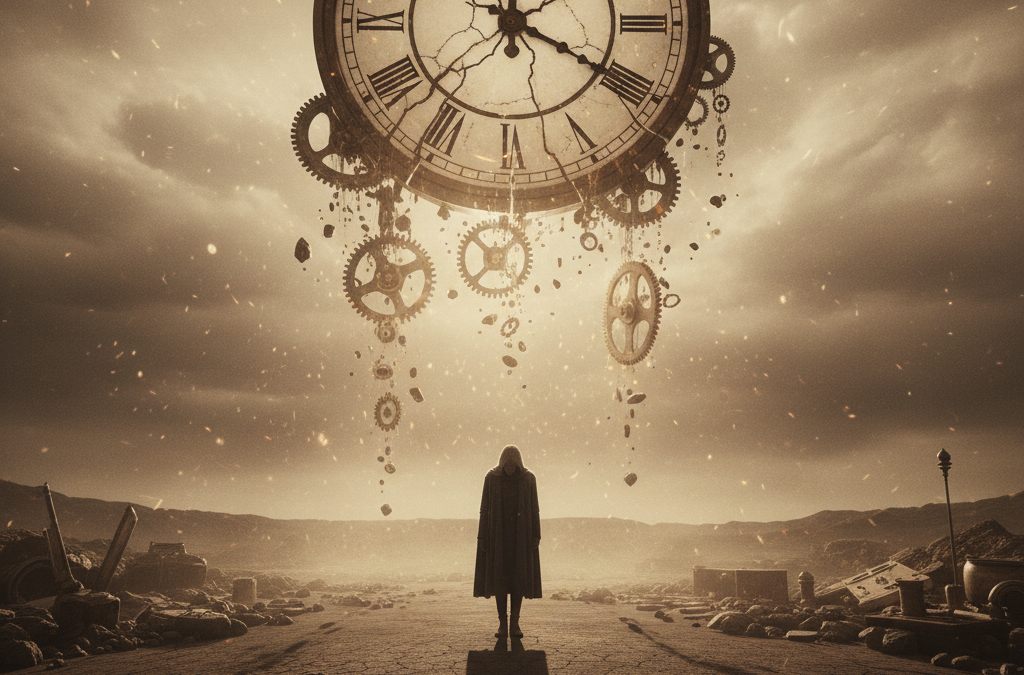
Our world has an anxiety problem.
We feel it in our bodies before we can explain it with words. We wake up already tired. We scroll, refresh, check, and compare. We fear falling behind, missing out, wasting our lives, or making the wrong decision and being trapped by it forever. The future feels fragile. The past feels heavy. The present feels rushed.
This is not just about personality or temperament. It is not only social media, economics, or politics — though all of those intensify it. Beneath the surface, something deeper is pressing on us.
We are anxious because of time.
Not because time exists, but because we no longer know what it means.
When Time Feels Like an Enemy
We live with constant awareness of time passing, yet without a shared story about where it is going. Our phones measure it down to the second. Our calendars divide it into meetings and milestones. Our culture slices life into stages: early success, mid-career peak, late-stage relevance.
And quietly, the clock becomes a judge.
When time is reduced to productivity, performance, or personal fulfillment, every hour becomes a test. If you are not maximizing it, you are losing. If you are not advancing, you are falling behind. Rest feels irresponsible. Waiting feels like failure.
The ticking that once sounded neutral now feels accusatory.
But Scripture suggests that our anxiety about time is not random. It points to something planted deep within us.
“He has put eternity into man’s heart” (Ecclesiastes 3:11).
We ache for permanence. We long for meaning that outlasts our calendars. When we cannot see where time is headed, eternity feels less like hope and more like pressure.
Time Without a Destination
Many ancient systems saw time as cyclical — endlessly repeating without final resolution. Modern secular culture rejects the cycle but keeps the uncertainty. Time moves forward, but toward what? Progress? Collapse? Nothing at all?
When the future has no promised fulfillment, every moment feels fragile. Meaning must be extracted quickly before it disappears.
Much of Western culture inherited the Bible’s sense that time has direction — but it has removed the One who directs it.
The result is subtle panic.
If history is not guided, then it must be managed. If there is no promised ending, then everything depends on us.
No wonder we are anxious.
The God Who Stands Outside the Clock
The Bible opens with a sentence that changes everything:
“In the beginning, God created the heavens and the earth” (Genesis 1:1).
Time has a beginning because God does not. Before sequence, before decay, before aging and waiting, God simply was. He did not emerge from time. He spoke, and time unfolded. That means the clock is not ultimate.
Time is not merely a measurement system. It is a form of revelation. The steady rhythm of days and seasons is God’s quiet way of making His faithfulness visible. Every sunrise is a reminder that He sustains what He began. The predictability of morning and evening is not a mechanical accident — it is covenant consistency. The God you cannot see has woven His reliability into the fabric of time itself.
Genesis shows time ordered and named: evening and morning, day after day. The sun and moon are placed “for signs and for seasons, and for days and years” (Genesis 1:14). Time is structured. It is purposeful. It moves somewhere. And it moves toward rest.
“So God blessed the seventh day and made it holy” (Genesis 2:3).
From the beginning, time was designed not to crush you, but to lead you into communion.
If that is true, then time is not something to survive — it is something to receive. The passing of hours is not proof that you are falling behind, but evidence that God is still governing history. The future is not an open void; it is territory already known to Him. When you understand that time is created and carried by God, anxiety begins to loosen its grip. The clock stops sounding like a threat and starts sounding like trust.
When Time Became Heavy
After sin entered the story, time began to feel like loss. Aging became decay. Waiting became painful. Deadlines brought pressure. The steady rhythm began to sound like a countdown.
We feel that shift deeply. Birthdays become measurements. Delays feel threatening. The future feels like something we must secure before it slips away.
Yet Scripture refuses to treat time as broken beyond hope.
“When the fullness of time had come, God sent forth his Son” (Galatians 4:4).
Not randomly. Not accidentally. At the right time.
The cross happened at an appointed hour. The resurrection came on the third day. History did not spiral. It moved toward a moment.
Time was not abandoned after the fall. It was entered. God did not merely send a message into time — He sent Himself. He was born at a measurable hour, grew through real years, walked dusty roads, and died on a specific afternoon. The invisible became visible not in mythic timelessness, but in dates and days. Time itself became the stage where God could be seen.
Not Erased, but Healed
When people imagine heaven, they often picture time disappearing — an endless, static “now” where nothing changes. At first, that sounds peaceful. But if nothing unfolds, nothing can be enjoyed. Love requires sequence. Joy deepens over moments. Worship rises and responds. Conversation moves forward.
Scripture never says that time is destroyed in the age to come. It says something better.
The Bible ends not with souls floating outside history, but with a renewed world. Revelation speaks of nations, kings, and a tree that bears fruit “each month” (Revelation 22:2). Those are time-shaped images — rhythm, growth, shared life.
Heaven is not timelessness. It is time set free from decay.
The curse that made time feel like loss — aging, regret, death — is removed. “Death shall be no more” (Revelation 21:4). When death is gone, time is no longer a countdown. It becomes open-ended joy.
Isaiah envisions a future where life is no longer cut short, and labor is no longer in vain (Isaiah 65:22–23). Duration remains. Meaning remains. But frustration is healed.
In True Fantasy terms, heaven is not when the book snaps shut. It is when the story finally breathes without fear of interruption.
Time is not erased. It is redeemed.
True Fantasy Reflection: Living Without Panic
If time began with God and ends in restoration, then we are not trapped between meaningless moments.
What we do now matters. Our choices are not swallowed by oblivion. Our stories are not deleted but completed. The wounds of earlier chapters are not ignored; they are healed.
Psalm 90 prays, “Teach us to number our days, that we may gain a heart of wisdom.”
To number your days is not to panic over them. It is to live awake inside a story that has direction. It is to trust that the Author who began time will also fulfill it.
Our world has an anxiety problem because it has forgotten what time is for. The gospel answers that question.
The clock is still ticking. But it is not ticking toward nothing. It is moving toward wholeness.
And the One who began the story in light is faithful to carry it all the way home. The creation of time was never meant to imprison you. It was meant to teach you. Every passing day is a reminder that history has an Author, that your life has direction, and that the invisible God is not absent. He has written Himself into the hours. The weight of the clock is real — but so is the hand that holds it.
Keep reading: Chapter 10: An Intimate Relationship With Dirt