
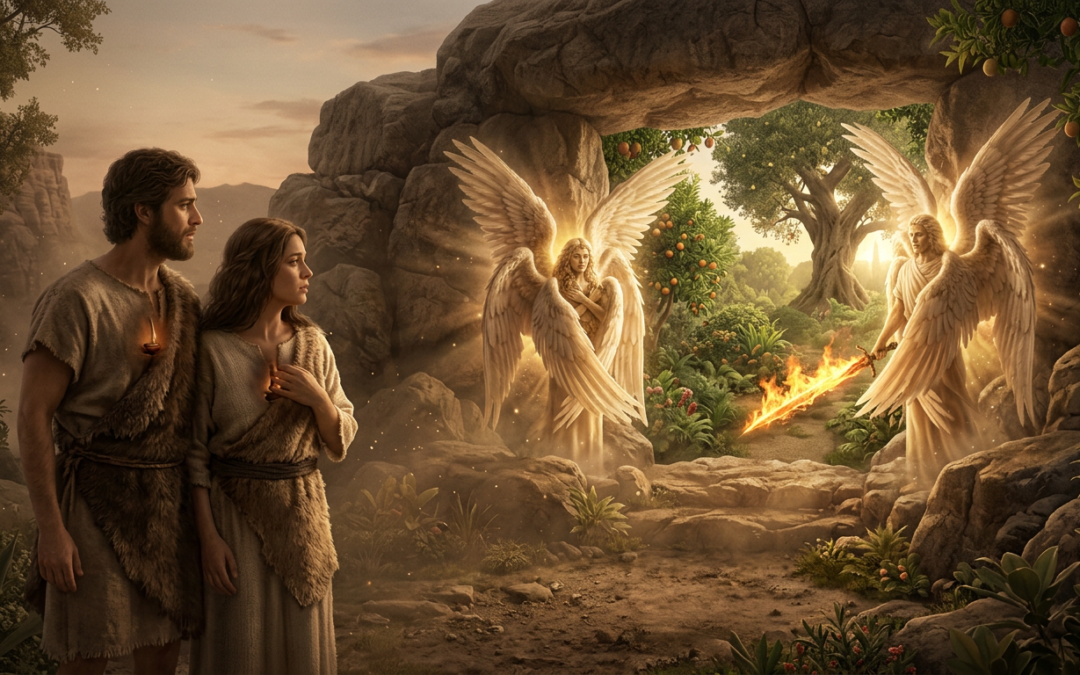
Genesis 3 is the chapter where death enters the story. We cannot finish this discussion without answering the most important question: What died?
That is not a small thing. Up to this point, the world has been filled with life. Light breaks into darkness. Waters gather. Trees rise from the ground. Birds fill the sky. Beasts move across the earth. Adam breathes with the breath God gave him, and Eve stands beside him in the garden of delight. Everything is alive because everything is held in the goodness of God’s presence.
Then the serpent speaks.
“You will not surely die.”
That lie hangs over the rest of the chapter. God had warned Adam that if he ate from the tree of the knowledge of good and evil, he would surely die. The serpent denied the warning and offered a different vision of reality. He made death sound like an empty threat. He made disobedience sound like a doorway into wisdom. He made rebellion look like ascent.
So Adam and Eve ate.
And at first, the serpent seemed right.
They did not fall to the ground. Their bodies did not stop breathing. Their hearts kept beating. Their eyes opened. Their minds still worked. Their wills still made choices. Their emotions still moved within them. They felt shame. They felt fear. They desired cover. They thought, planned, hid, spoke, blamed, and listened. They were still human. They were still alive in many visible ways.
But something died.
The question is not whether death entered Eden. God said it would, and God does not lie. The question is: what died first?
It was not the body, at least not immediately. Physical death entered their future, and from that moment their bodies began moving toward dust. But Adam did not become a corpse beneath the tree. Eve did not collapse beside him. Their physical death was certain, but it was not instant.
It was also not the soul, if by soul we mean the mind, will, and emotions. After they sinned, Adam and Eve were still thinking, choosing, desiring, fearing, and feeling. In fact, Genesis 3 shows their souls in painful motion. Their minds searched for an answer. Their wills chose hiding. Their emotions filled with shame and fear. Their desires turned inward. The soul was wounded, darkened, and disordered, but it was not gone.
So what died?
The spirit died.
That may sound strange at first, partly because Scripture often speaks of the soul and spirit together. Sometimes the Bible uses words like soul, spirit, and heart in ways that overlap. Hebrews 4:12 even says that the Word of God is able to pierce “to the division of soul and of spirit,” which suggests that these things are so closely joined that only God’s own Word can fully distinguish them. We should speak carefully here, because human beings are not machines with neat compartments. We are living mysteries, formed by God from dust and breath.
Still, Genesis 3 shows us that something inside humanity lost its living connection with God. The body remained alive. The soul remained active. But the deepest place of communion went dark.
Call it spirit. Call it heart. Call it the inner sanctuary of the human person. Whatever word we use, this was the place made to receive, know, and answer God. It was the lamp within Adam and Eve, lit by the nearness of the Lord. It was the throne room of the human creature, the place where God’s presence was meant to rule and shine.
When they sinned, that inner lamp went out.
This is where True Fantasy helps us see what plain explanation often flattens. Genesis 3 is not only about rule-breaking. It is about a living temple losing its fire. Adam and Eve were not merely people who made a bad choice. They were image-bearers whose inner sanctuary was severed from the presence that gave it life.
Before sin, Adam and Eve were open before God and one another. They were naked and unashamed because nothing in them was turned away from the light. Their bodies, souls, and spirits were in harmony. The body served life. The soul delighted in truth. The spirit communed with God. The whole person was ordered toward the Lord.
After sin, that order shattered. Their eyes were opened, but not with glory. They saw their nakedness and covered themselves. They heard God’s voice and hid among the trees. The same presence that had been their joy now felt like danger. The garden had not changed first. They had.
This is spiritual death: not the end of existence, but the loss of communion with God.
Spiritual death does not mean a person becomes less human. It means the deepest part of the person is cut off from the Life it was made to receive. A dead spirit can still dwell inside an active body and a busy soul. It can think, plan, build, create, desire, love wrongly, fear deeply, and chase meaning across the earth. It can make cities, songs, weapons, towers, and kingdoms. It can even become religious. But without God’s life, the inner sanctuary remains dark.
That is why the rest of Genesis unfolds the way it does. Adam and Eve do not become monsters at once, but the fracture spreads. Cain brings an offering, but envy crouches at his door. Lamech boasts in violence. The sons of God and daughters of men mark a deepening corruption. Babel rises like a monument to human greatness without surrender. The body is alive. The soul is brilliant and restless. But the spirit is dead toward God, and the world becomes haunted by the consequences.
The serpent’s lie was clever because it contained just enough delay to seem true. Adam and Eve did not die physically in that moment, so the lie could whisper, “See? Nothing happened.” But everything had happened. Death entered at the root before it appeared in the branches. The invisible died before the visible decayed.
That is how death often works in Scripture. The seen world reveals the unseen one. Bodies return to dust because humanity has already been severed from the God of life. The grave is the final outward sign of an inward catastrophe. Physical death is terrible, but it is not the deepest death. The deepest death is to be physically alive in God’s world while spiritually dead to God Himself.
This also explains why salvation must be more than forgiveness from a distance. If our problem were only guilt, we would need pardon. If our problem were only ignorance, we would need instruction. If our problem were only weakness, we would need help. But if our spirit is dead, we need life.
That is why Scripture speaks of being born again. When the Holy Spirit comes to a new believer, He does not merely improve behavior or polish the soul. He regenerates. He gives life where there was death. He enters the darkened sanctuary and kindles the flame again.
The mind begins to see differently because the spirit has been made alive. The will begins to turn because the spirit has been awakened to God. The emotions begin to be reordered because the spirit is no longer sealed in darkness. Regeneration does not make a person instantly mature, but it does make him alive. The old fracture begins to be healed from the deepest place outward.
This is why the Christian life is not simply moral reform. It is resurrection beginning inside the human person. The Spirit of God brings life to the spirit of man, and from there the restoration spreads. The soul is renewed. The body becomes an instrument of righteousness. Communion with God is restored, not yet in full sight as Eden once was, but truly and powerfully through Christ.
From a True Fantasy perspective, this is one of the great hidden wonders of the biblical story. The world is full of walking ruins and buried temples. Human beings are not merely animals with large brains. They are fallen sanctuaries. Some are darkened. Some have been relit. In every person, there is more than flesh, thought, and feeling. There is a deep place meant for God.
Genesis 3 shows the moment that deep place died.
The tragedy is not only that Adam and Eve were sent out of the garden. It is that the garden was sent out of them. The inner Eden, the place of unhindered communion, was lost. The gate closed not only behind them, but within them. Cherubim stood at the outer entrance with flaming sword, while another kind of exile opened in the human heart.
This is why shame came so quickly. Shame is what happens when the soul feels the spirit’s loss but cannot heal it. This is why fear rushed in at the sound of God’s voice. Fear is what happens when the presence we were made for becomes the presence we flee. This is why blame followed. Blame is what happens when the self curves inward and tries to survive without confession.
Something died, and everything else began to break around it.
Yet even here, the story is not without mercy. God did not allow Adam and Eve to eat from the Tree of Life in their fallen state. He guarded the way, not because He hated them, but because endless life with a dead spirit would be endless ruin. The sword at Eden was severe mercy. It prevented immortality from becoming a curse.
And then, from that point forward, the whole story of Scripture begins moving toward a greater question: How can the dead live again?
The answer will not come through human effort. Dead things do not raise themselves. The answer will not come through better civilization, stronger kings, deeper emotions, sharper minds, or stricter laws. Those may restrain, guide, expose, or organize, but they cannot breathe life into the dead spirit.
Only God can do that.
The same God who breathed into Adam must breathe again. The same voice that said, “Let there be light,” must speak into the inner darkness. The same Spirit who hovered over the waters must move over the ruined depths of the human heart.
That is the wonder of regeneration. It is not self-improvement. It is not religious decoration. It is not a dead man learning to act alive. It is the Spirit of God entering the hidden tomb of the human spirit and saying, “Live.”
So what died in Genesis 3?
The body began to die. The soul was wounded and disordered. But the spirit, the deepest place of communion with God, died first.
That is why Eden was lost. That is why the world groans. That is why the human heart became a haunted house, full of memory, longing, fear, and pride. And that is why salvation must be nothing less than new birth.
Beyond the trees, beyond the fig leaves, beyond the hiding and the blame, the real horror of Genesis 3 is this: humanity remained visibly alive while becoming spiritually dead.
But the real hope is greater still.
What died can live again.
This is the miracle of all miracles!