
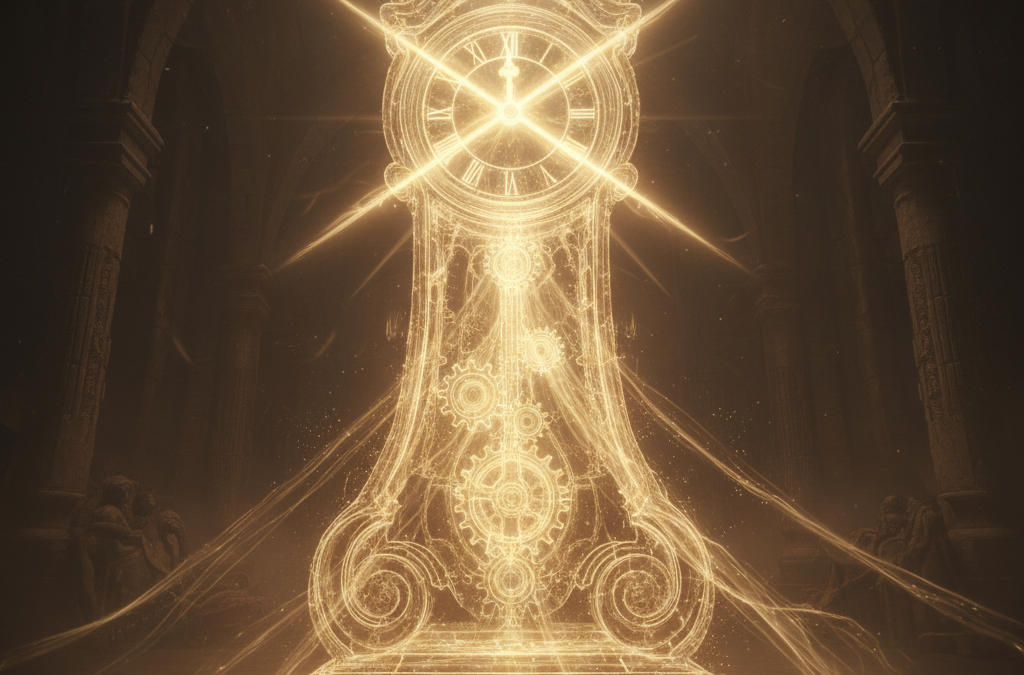
We live inside something we cannot see.
You cannot hold time in your hands or pour it into a jar. You cannot point to it the way you point to a tree or a mountain. And yet you trust it every single day. You wake up because of it. You plan your life around it. You feel it passing, even when you try not to think about it.
Time is invisible — and still it quietly governs your life. That alone should make us slow down and think.
In the opening chapter of Genesis, before cities rise, before oceans are filled with living creatures, before the sun and moon are even placed in the sky, something quiet and astonishing happens: time begins.
“In the beginning, God created the heavens and the earth.” (Genesis 1:1)
That phrase does more than introduce a story. It tells us that time itself has a starting point. There was a moment when moments began. Before that, there was no ticking clock, no sequence of events, no yesterday fading into memory.
God did not step into time as though it were already running. He spoke it into existence.
And here is something even more striking: time begins with light.
“And God said, ‘Let there be light.’ … And there was evening, and there was morning—the first day.” (Genesis 1:3–5)
Notice the order carefully. Light appears first. Then comes the first day. Time is measured by the separation of light and darkness. Without light, there is no day. Without day and night, there is no rhythm. And without rhythm, there is no way to measure time at all.
Light makes time visible.
And time, in turn, makes the invisible God visible.
The Framework of Creation
Genesis 1 unfolds with careful structure. God forms the realms during the first three days, and then fills them in the next three. Yet woven through the entire chapter is a repeated pattern:
“And there was evening, and there was morning…”
Each day is named and counted. Each one has order. Then on the fourth day, God sets the sun, moon, and stars in place “to mark sacred times, and days and years” (Genesis 1:14).
The lights in the sky are not only for beauty or warmth. They are placed there to govern time — to mark seasons and to guide worship. Time is not random movement. It is ordered for meaning.
In some ways, time is the framework of creation. Not because it is greater than light or land or living creatures, but because everything else unfolds within it. Time frames every other part of creation.
And yet you cannot see it directly. You only see its effects. You see shadows stretch across the ground. You see children grow taller. You see leaves change color and fall.
Time trains you to trust what you cannot see.
Every single day, you depend on something invisible. That dependence is not small. It is shaping you.
Light and Time Bound Together
A pattern runs from the first chapter of the Bible to the last. Time begins when light appears, and Scripture closes with these words:
“There will be no more night… for the Lord God will give them light.” (Revelation 22:5)
The story begins with light dividing day from night. It ends with a light that never fades.
Time begins in light, and it ends in light.
This is not accidental poetry. It is direction. The Bible does not describe history as a circle that spins forever. It describes a story that moves somewhere — from creation to fall, from redemption to restoration.
Time has an arrow, and that arrow points to God.
The Invisible That Governs Us
Time is one of the few created realities you cannot see directly. You see sunsets and clocks, but you never see time itself. You feel it. You measure it. You are shaped by it.
Time moves whether you notice it or not. The steady ticking of the second hand is more than background noise. It is a quiet reminder that God governs every minute detail of creation, faithfully administering each passing moment without pause or mistake. Nothing interrupts it. Nothing overrules it. It humbles you and reminds you that you are not in control. Psalm 90 says, “Teach us to number our days, that we may gain a heart of wisdom.”
To number your days is to admit they are limited. It is to admit that you are not eternal on your own. Time exposes your limits, but at the same time, it illuminates God’s eternity.
From everlasting to everlasting, He is God.
You are carried along in time, while He stands over it. That difference changes everything.
When Time Became Heavy
In the beginning, time was pure rhythm — evening and morning, work and rest. It was a gift.
After sin entered the world, however, time began to feel different. It began to feel like loss. Aging became decay. Waiting became painful. Deadlines brought pressure. The steady rhythm started to sound like a countdown.
What was once music became a monotonous ticking.
And yet even here, time still points to God. Paul writes that Christ came “in the fullness of time” (Galatians 4:4). Jesus did not arrive too early or too late. The cross happened at a set hour. The resurrection came on the third day.
God does not rush, and He does not delay. He moves in perfect timing.
Time bends toward redemption, even when it feels heavy.
The True Fantasy
There is something about this that feels like great fantasy — and yet it isn’t fiction. In every great story, there is a hidden order beneath the events. There is a sense that time itself is guiding the hero toward something larger.
Scripture claims that this is not just imagination. It claims the Author of time stepped into His own timeline.
When Jesus says, “Before Abraham was, I am” (John 8:58), He speaks as One who stands outside the story while standing inside it. He is not trapped in time. He entered it.
That is the deeper wonder of God’s story.
The Invisible stepped into the visible. The Eternal stepped into the clock. And by doing so, He made time itself a signpost. We even measure our history by his birth. Whether you call it BC and AD or BCE and CE, both have the life of Jesus as the fulcrum.
Every sunrise whispers that the story is still moving. Every season declares that order still holds. Every birthday reminds you that your days are counted — not by chance, but by design.
Time is not your enemy. It is your teacher. It reminds you that you are not self-sufficient. It trains you to depend on what you cannot see. It quietly points you to the Author.
Even in Eternity
We often imagine eternity as endless time, but Scripture hints at something deeper. In the new creation there will be no night, no fading light, and no decay. Time as we know it — marked by shadow and loss — will be transformed.
Yet it will still point to God.
Because even if clocks fall silent, the story will not lose its direction. It will reach fulfillment. Time began when God said, “Let there be light,” and it ends when God Himself is the light.
From first dawn to final glory, time stands as a witness.
True Fantasy Reflection
We live inside something invisible that shapes everything we see.
You cannot stop time or slow it down. You cannot bargain with it. But you can learn from it. If time was created by God, then every passing day is not random — it is given. If light marks time, then every sunrise is a reminder that you are still inside the story He is writing.
“Teach us to number our days.”
Numbering your days does not mean living in fear. It means living awake. It means refusing to drift. It means recognizing that the invisible order shaping your life is not chaos but calling.
In the True Fantasy Scripture tells, time is not a cage. It is a compass.
It began in light.
It is moving toward light.
And every passing day is quietly pointing you to the One who stands outside it — and yet entered it for you.
Number your days.
Not because they are slipping away, but because they are leading somewhere.
Keep reading: Chapter 9: The Weight of the Clock