
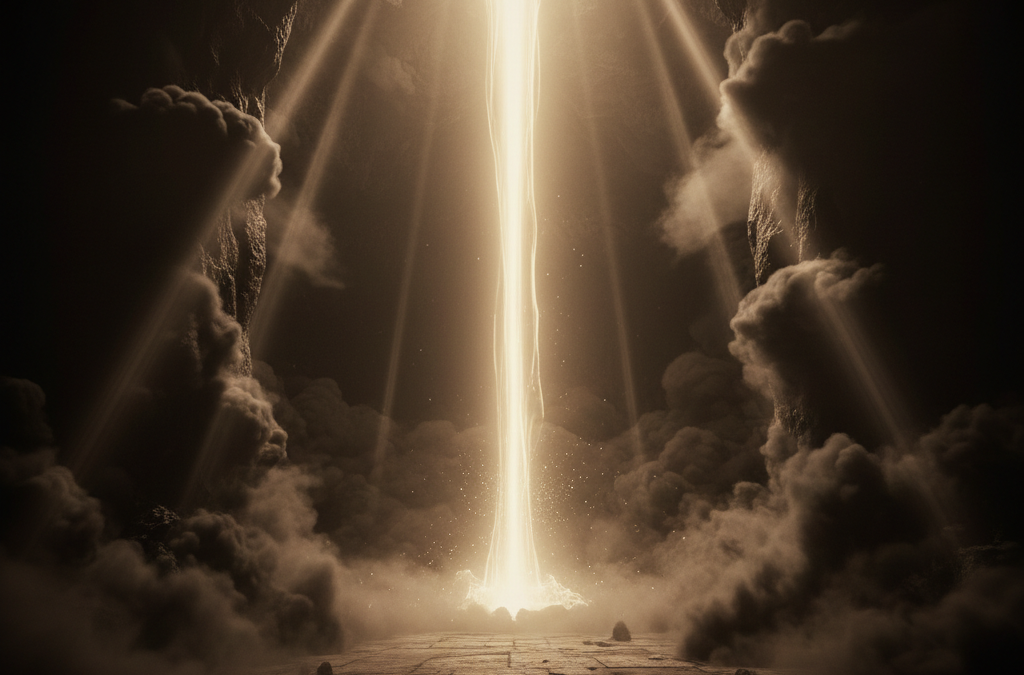
Most of us do not think of darkness as neutral. We think of it as danger. As evil. As the place where things go wrong, and God feels absent. Shadows are a threat. Night creates vulnerability. From childhood on, we are trained to equate darkness with something to fear.
But Scripture begins somewhere very different.
Before sin had entered the human story — before rebellion, before shame, before death — the world lay beneath darkness, and nothing in that darkness was evil.
In the opening lines of Scripture, before sin entered the world and before fear or death had a name, the world lay quiet and unformed beneath a veil of darkness. There was no villain hiding in the shadows, no corruption twisting the deep. There was only stillness. Darkness was not a threat; it was a pause, a breath held before the first word was spoken.
“Now the earth was formless and empty, darkness was over the surface of the deep, and the Spirit of God was hovering over the waters.” (Genesis 1:2)
What is striking is not the presence of darkness, but God’s response to it. He does not recoil, nor does He rush to destroy it. He hovers. He remains present.
The first thing Scripture shows us about darkness is not its danger, but His presence inside it. Before light ever appeared, God was already there. Which means whatever darkness you are standing in now is not unoccupied territory. The Invisible God does not wait outside the shadows. He hovers in them.
But He doesn’t just hover in them, He speaks into darkness, including your darkness. We see this in Genesis 1:3: “And God said, ‘Let there be light.’”
Light does not battle darkness here. It simply arrives. Darkness does not resist. It gives way.
God does something even more surprising next—He names both light and darkness, calling one Day and the other Night (Genesis 1:5). In doing so, He claims authority over them both. Darkness, at the beginning of the world, is not evil or dangerous. It belongs. It exists under God’s rule, waiting to be shaped by His word.
This is a truth ancient storytellers seemed to understand instinctively. In the best fantasy and myth, creation often begins in shadow. Not because shadow is wicked, but because something is about to be born. Darkness is the quiet before the song, the blank page before the tale is written. It is not the enemy. It is potential.
That meaning changes only after the fall.
When humanity turns from God, darkness slowly gathers a new weight. It becomes a symbol not of mystery, but of distance. No longer the stillness before creation, it becomes the space where truth is avoided, and light is refused. The prophets describe people stumbling through darkness because they have chosen to walk away from what reveals (Isaiah 9:2). Jesus Himself names the shift with painful clarity.
“Light has come into the world, but people loved darkness instead of light because their deeds were evil” (John 3:19)
Darkness is no longer neutral because it is no longer passive. It is chosen. It becomes a place of hiding, of denial, of separation. Darkness becomes moral when we prefer it. When we would rather not see. When exposure feels more threatening than deception. The danger is not that darkness exists — it is that we choose it because light would cost us something.
What’s incredible is that Jesus chose darkness for us so we could choose light. The deepest expression of darkness comes at the cross. When Jesus is crucified, the sky grows dark in the middle of the day.
“From noon until three in the afternoon, darkness came over all the land” (Matthew 27:45).
This darkness is not abstract. It is ours. Every hidden thing. Every refusal. Every quiet rebellion we rename as independence. The sky darkens not because God is absent, but because God is absorbing what we created.
The Gospels describe a moment when creation itself seems to draw back, when light withdraws as the Son bears the full weight of human rebellion. For a brief time, the world echoes Genesis again—but this time the darkness carries grief. It carries judgment. It carries the cost of love.
Yet even here, darkness does not win. It does not last. Just as light followed the first darkness in Genesis, resurrection follows the darkness of the cross. The pattern remains unbroken.
Great fantasy stories understand this pattern, even when they do not name its source. They know that evil does not create—it corrupts. Shadow is not dangerous until it is twisted by pride, fear, or the desire for control. Even in modern myth, darkness comes not from the absence of power, but from the refusal to trust anything beyond oneself.
The Bible says the same thing, though with sharper clarity.
“Your word is a lamp for my feet, a light on my path” (Psalm 119:105).
Light reveals. Darkness conceals. And concealment only matters when something has gone wrong.
What makes Christianity different from many stories is not that it promises escape from darkness, but that it insists God enters it. Scripture does not pretend that suffering is unreal or that the shadow is an illusion. It says the Light stepped directly into the darkest place we created and was not overcome by it.
“The light shines in the darkness, and the darkness has not overcome it” (John 1:5).
That truth matters because darkness is not only cosmic or historical. It is personal.
Most people carry some form of shadow within them—not dramatic villainy, but quieter things. Shame that never quite leaves. Fear that shapes decisions. Anger that feels justified but heavy. A sense of absence, as if something essential is missing but unnamed. This kind of darkness does not feel like evil so much as distance, and that distinction matters deeply.
If darkness were pure evil, you could fight it with willpower. But if darkness is separation from the Source of life, then no amount of self-improvement will save you. The only way out is to turn toward the One you have been avoiding.
The Bible calls that turning repentance, not as punishment, but as direction.
“If we walk in the light, as He is in the light, we have fellowship” (1 John 1:7).
Walking implies movement. It implies process. Light is not a switch flipped in a moment; it is a path chosen again and again.
Leaving darkness rarely looks dramatic. Often it begins quietly, with honesty. By admitting you are lost. By loosening your grip on control. By asking questions instead of resisting them. By reading God’s Word, not to argue, but to listen. By praying even when you are unsure anyone is listening.
Jesus makes a claim that is either completely false or unbearably true.
“I am the light of the world. Whoever follows me will not walk in darkness, but will have the light of life” (John 8:12).
If this claim is not true, Christianity collapses. If it is true, then every shadow in your life is an invitation to look up and follow. We like to imagine neutral ground exists, but Scripture insists that direction always matters. You are either walking toward Light or training your eyes to prefer the dark.
True Fantasy Reflection
In every true story worth telling, darkness comes first—not to win, but to wait. Before it was twisted by sin, darkness was simply the place where light had not yet spoken. The Bible claims the Light entered the world anyway, stepped into shadow willingly, and still does. If you are walking in darkness now, the story is not finished. Light does not demand perfection—it gives direction. And in the True Fantasy, the Bible does not ask you to deny the darkness. It dares you to look for God inside it. The Invisible God has always moved in shadow before He speaks light. The question is not whether He is present. The question is whether you will turn your face toward Him when He speaks.
Keep reading: Chapter 8: The Story Inside the Clock