
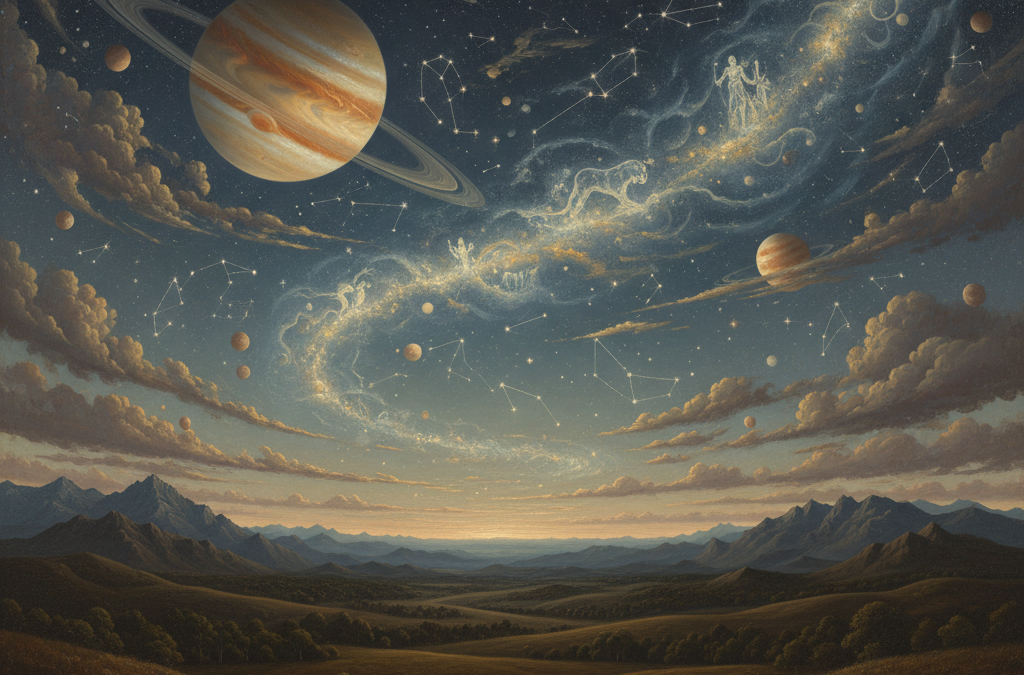
In the iconic Doctor Who episode “The Stolen Earth,” the universe is thrown into chaos as planets from across the cosmos converge in the skies above Earth. It’s a breathtaking yet ominous sight—worlds colliding, moons trembling, and the heavens alive with celestial drama. The Doctor races to uncover the sinister force behind this cosmic catastrophe, but viewers are left marveling at the grandeur and fragility of the universe. This fictional event serves as a powerful reminder of the mysteries and wonders that surround us in the vast expanse of the heavens.
The heavens have always captured the human imagination, inspiring awe, curiosity, and reflection. From the ancient stargazers who charted the stars to modern astronomers peering into the edges of the known universe, our fascination with the skies above has persisted through time. Episodes like “The Stolen Earth” tap into this universal yearning to understand the cosmos, blending science fiction with deeply human questions about our place in creation. What would it mean for the heavens to literally descend upon us? How do we reconcile the beauty of the stars with their potential for destruction?
While the collision of planets may be confined to the realm of science fiction, the vastness and complexity of the heavens are very real. They speak to a Creator whose power and imagination exceed our comprehension. Whether through the lens of a telescope or the storytelling of a beloved TV series, the heavens remind us of the intricate balance that holds all things together—and the responsibility we have to marvel, protect, and seek understanding.
The Jewish historian Flavius Josephus provides a fascinating account of Abraham’s journey to understanding the divine by contemplating the heavens. In his work Antiquities of the Jews, Josephus describes how Abraham, long before the revelation of God in Scripture, came to recognize the existence of one true Creator. Living in a time and culture steeped in idolatry, Abraham rejected the worship of multiple gods. Instead, Josephus claims he observed the natural world—particularly the heavens—and concluded that such magnificent order could only come from a singular, all-powerful God.
 Josephus writes that Abraham’s reasoning was rooted in the harmony and precision of the celestial bodies. The regularity of the sun’s path, the phases of the moon, and the constancy of the stars convinced him that these were not random phenomena, nor could they be attributed to numerous competing deities. Abraham reasoned that such an intricate design must point to a single Creator who governed all things. According to Josephus, this profound insight set him apart from his contemporaries and marked the beginning of his journey as the father of monotheism.
Abraham’s reflections on the heavens echo across time, reminding us of the ways creation declares the glory of God. Just as the Psalmist proclaimed, “The heavens declare the glory of God; the skies proclaim the work of His hands” (Psalm 19:1), so too did Abraham perceive the evidence of the divine in the vastness above. His story challenges us to look beyond the beauty of creation and see the Author behind it—a God who not only set the stars in motion but also calls us into a relationship with Him. Through Josephus’ account, we are reminded of the timeless truth that the heavens are more than a spectacle; they are a testament to the one true Creator.
Genesis 1:1, “In the beginning, God created the heavens and the earth,” serves as the foundational declaration of the Bible, establishing God as the ultimate Creator of all things. This verse underscores that God existed before time, space, and matter, and that He sovereignly brought the universe into existence out of nothing (“ex nihilo”) but Himself. The phrase “the heavens” refers not only to the physical expanse of the sky and outer space but also to the spiritual realm—highlighting God’s creative authority over both the visible and invisible aspects of creation. This opening verse sets the stage for the rest of Scripture, emphasizing that everything begins with God and His eternal power.
Genesis opens not with speculation, but with intention. It frames the heavens as a testimony to God’s glory, as later affirmed in passages like Psalm 19:1.
This verse also carries implications for the relationship between God and His creation. God’s act of creating the heavens demonstrates His transcendence—He is above and beyond the universe—and His immanence, as He is actively involved in sustaining and governing it. By stating that God created the heavens “in the beginning,” Genesis 1:1 affirms that time itself is part of God’s creation, further emphasizing His eternal nature. This opening declaration reminds us that the heavens, with all their grandeur and complexity, were intentionally designed to point humanity toward the Creator.
The Heavens Declare to Every Generation!
What Doctor Who captures—perhaps unintentionally—is something Scripture has always understood: the heavens are not small, tame, or sentimental. They are vast, overwhelming, beautiful, and terrifying. They inspire wonder precisely because they are beyond us. When planets gather in the sky and the universe feels suddenly fragile, our instinctive response is awe mixed with fear. That instinct is not a flaw in human psychology—it is a clue. We were never meant to look at the heavens and feel in control.
This is where True Fantasy begins to emerge. Fantasy is not escapism when it points us toward reality rather than away from it. The best stories do not shrink the universe to human size; they expand the human heart to encounter something greater. In Scripture, the heavens are not mere decoration or backdrop. They are theater—God’s chosen stage to reveal His power, His order, and His eternity to every generation that lifts its eyes.
Unlike fictional universes where cosmic chaos threatens existence itself, the biblical heavens are immense yet governed. They move with freedom, but never with rebellion. Stars burn for ages without exhausting their purpose. Galaxies spin in silence, obedient to laws they did not create. This is not because the universe is divine, but because it is commanded. The heavens are not gods. They are witnesses.
That distinction is crucial. Pagan myth, ancient and modern alike, often turns the cosmos into a battleground of rival powers or impersonal forces. Science fiction frequently mirrors this anxiety—worlds colliding, time unraveling, existence hanging by a thread. Scripture offers something far more staggering: a universe so vast that it humbles humanity, yet so ordered that it reveals the faithfulness of its Creator. Chaos exists, but it is not sovereign. Immensity does not imply meaninglessness. Eternity does not erase purpose.
This is why Abraham’s reflections matter so deeply. Long before telescopes, long before Scripture was written, long before Israel existed, a man looked at the sky and realized that multiplicity demanded unity. The heavens did not suggest many gods competing for control, but one God sustaining harmony. Abraham’s insight was not mystical guesswork—it was reverent reasoning. Order implies intention. Beauty implies mind. Continuity implies faithfulness. The heavens preached long before Moses wrote.
That same sermon has been preached to every generation since.
Children still stare at the night sky with instinctive wonder. Scientists still confess how small humanity feels when confronted with cosmic scale. Poets, artists, and storytellers still reach for language that strains to hold the weight of the stars. The heavens speak across cultures and centuries because they are not locked into one moment of history. They belong to eternity—and eternity belongs to God.
Genesis 1:1 anchors this truth firmly: “In the beginning, God created the heavens and the earth.” This is not merely a statement of origin; it is a declaration of identity. Before there was light to see by, space to explore, or time to measure, God already was. The heavens are not eternal—He is. They did not give birth to Him—He spoke them into being. Their vastness does not rival His glory; it reflects it.
This is why the heavens qualify as True Fantasy in the deepest sense. They are more wondrous than myth, more expansive than imagination, and more enduring than fiction—because they are real. They stretch beyond the limits of human storytelling while simultaneously inviting humanity into a story authored by God Himself. Fantasy often asks, “What if?” Scripture declares, “This is.”
And that truth carries comfort as well as awe. The same God who flung galaxies into existence is not distant from human history. He names stars—and He names people. He governs the motions of heaven—and He enters time in flesh. Eternity does not make Him indifferent; it makes Him faithful. The heavens proclaim not only His power, but His consistency across generations.
From Abraham gazing upward in the ancient world, to David singing beneath the stars, to modern viewers marveling at fictional skies filled with converging planets, the human response remains the same: wonder. Scripture does not correct that response—it fulfills it. The heavens are meant to overwhelm us just enough to remind us that we are not the center of the story. God is.
And that is the heart of True Fantasy: not escape from reality, but awakening to it. Not shrinking God to fit our imagination, but allowing our imagination to be expanded by who God truly is—eternal, immeasurable, sovereign, and present. The heavens endure, generation after generation, because they serve a single purpose: to remind humanity that the story is bigger than us, and that the Author still reigns.
Keep reading: Chapter 7: Before Darkness Met Evil