
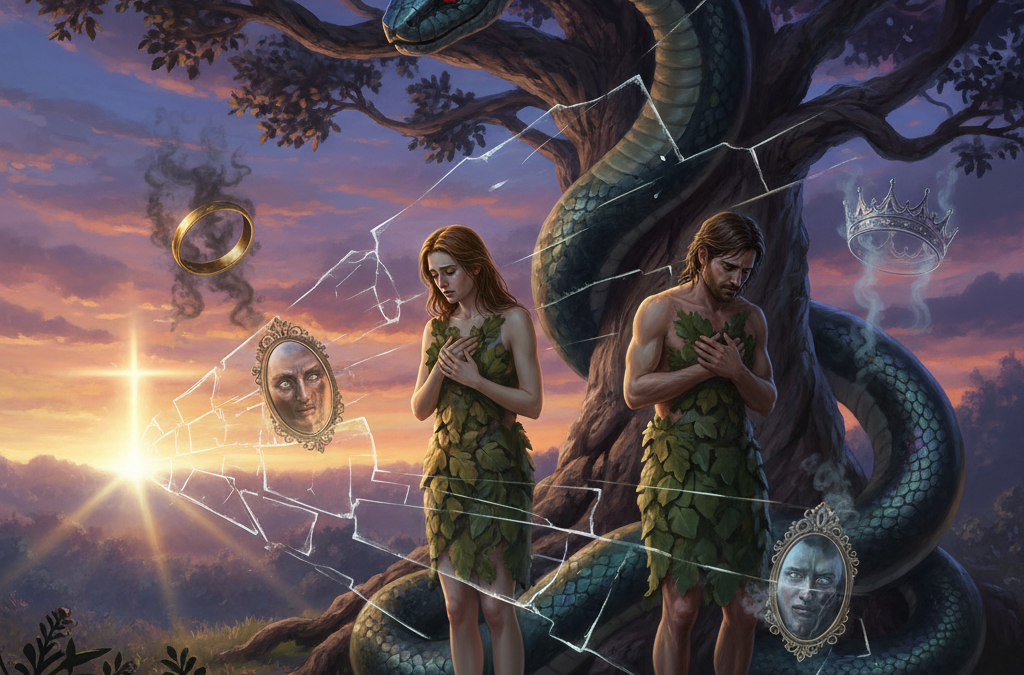
Marriage was the first structure the serpent attacked, but it was not the last thing in his sights. Beneath the question about God’s Word and beneath the fracture of husband and wife, there was something even deeper at stake. The serpent was not only challenging obedience; he was waging war against identity itself.
In the garden, Adam and Eve did not have to discover who they were. They did not need to invent meaning or search for purpose. Their identity was given. They were image-bearers of the Invisible God, formed by His hands, known by His voice, and placed in a world that reflected His goodness. They did not define themselves; they received themselves. They were naked and unashamed because there was nothing to hide and nothing to prove. Their worth did not depend on performance or comparison. It rested in the Word of the One who made them.
The serpent’s next move was subtle and deadly. After asking, “Did God really say…?” he made a promise. “You will not surely die,” he said. “Your eyes will be opened. You will be like God, knowing good and evil.”
He contradicted God directly. He promised life where God had warned of death. He offered sight where there was already clarity. He suggested elevation where there was already honor. He did not tempt them with ugliness but with improvement. He did not invite them to rebellion in crude terms; he invited them to self-determination.
You can almost hear the appeal. Why remain under command when you can choose for yourself? Why trust another’s definition of good and evil when you can decide? Why live as creatures when you can step closer to the Creator?
The offer sounded like growth. It was, in truth, separation.
The serpent did not tell them that death would indeed come. Physical death would unfold slowly, like a shadow stretching across the years, but spiritual death would strike at once. The moment they broke trust with God’s Word, their living connection to Him would fracture. The breath in their lungs would remain, but the life of communion would be severed. They would still walk, speak, and think, yet something essential would be lost. The light that once flowed freely between Creator and creature would dim.
He promised that their eyes would be opened. In a sense, they were. But he did not explain what they would see.
They would see themselves differently. They would see each other differently. They would see God differently. What had once been simple trust would become suspicion. What had once been freedom would become self-consciousness. What had once been joy would become fear.
The serpent offered godlikeness, but he concealed the cost of grasping at it.
This pattern echoes through the great stories we love. In many fantasy tales, a character is tempted with power that promises freedom and greatness. The ring that offers strength slowly consumes the one who wears it. The dark magic that promises protection begins to reshape the soul. The mirror that shows secret desires does not reveal the emptiness that follows. The offer always sounds the same: become more, rise higher, step beyond your limits. Yet the hidden truth is that the gift takes more than it gives. The hero who grasps at power apart from wisdom does not become stronger; he becomes divided.
Genesis tells the oldest version of that story. The serpent suggested that Adam and Eve were missing something, even though they lived in a garden planted by God. He implied that obedience was a boundary holding them back rather than a gift guarding their joy. He framed dependence as weakness and autonomy as maturity. The fruit became more than food; it became a symbol of self-creation.
That invitation was evil in its purest form because it twisted what was already good. They were already like God in that they bore His image. They were already crowned with dignity and given authority over creation. They did not need to become like God; they needed to remain under Him. The serpent’s promise was not about gaining something new but about abandoning the source of what they already had.
When they chose the fruit, the visible act revealed an invisible rupture. Spiritual death entered at once. The life of trust that defined them collapsed. Their identity shifted from received to constructed. Instead of resting in who God said they were, they began managing how they appeared. The first evidence of this shift was not triumph but shame.
Shame is the shadow of self-determination. It whispers that you must now protect yourself because you are alone. It tells you that exposure is dangerous because you no longer stand secure in another’s love. When Adam and Eve saw their nakedness and felt shame, they were experiencing the first fruits of spiritual death. The openness that once marked their relationship was replaced by guardedness. They reached for coverings because something inside them had already been stripped away.
The serpent did not warn them about this. He did not describe the sudden fear that would rise in their hearts when they heard the sound of the Lord walking in the garden. He did not mention the instinct to hide. He did not explain that self-definition would lead not to freedom but to isolation. He spoke of opened eyes but said nothing of closed hearts.
This is how the war over identity continues. The enemy still promises clarity while delivering confusion. He promises empowerment while planting insecurity. He promises freedom while weaving quiet chains. He tells men and women that they can define themselves apart from God’s design, that they can shape their own truth, that they can step beyond limits without cost. What he does not reveal is the loneliness that follows, the anxiety that grows when identity must be maintained, and the fear that comes when there is no higher Word to rest upon.
When identity is self-created, it must also be self-defended. Every disagreement becomes a threat. Every challenge feels like an attack. Without the anchor of God’s voice, the self drifts, constantly adjusting and redefining, never fully at peace. The promise of control becomes the burden of control. The promise of autonomy becomes the weight of isolation.
In fantasy stories, the character who seeks ultimate power often ends up enslaved by it, guarding it, hiding it, and fearing its loss. What was meant to bring greatness becomes a prison. So it was in Eden. The serpent offered Adam and Eve the chance to rise, but in grasping at that rise, they fell inward. Their world did not expand; it narrowed. Their relationship with God did not deepen; it fractured. Their unity did not strengthen; it strained.
This is the serpent’s war against identity. He cannot create, so he distorts. He cannot give life, so he imitates it. He cannot bear the image of God, so he seeks to blur it in those who do. His strategy is to convince image-bearers that they would be better off defining themselves. He whispers that dependence is weakness and that obedience is small. He hides the truth that life flows only from communion with the Invisible God.
Spiritual death was the immediate harvest of that lie. Physical death would come in time, but spiritual death began the moment trust broke. The living bond between Creator and creature was severed, and with it the deep assurance of being known and loved. The serpent’s promise of “you will not surely die” was exposed as deception. They did die, just not in the way they expected. They died to the life that mattered most.
Yet the story does not end in a garden of loss.
True Fantasy Reflection
The greatest miracle in all of history is not that the dead walk out of tombs, but that the spiritually dead are made alive. What was broken in a moment in Eden is restored through the long obedience of the Son. Where Adam reached for autonomy, Christ trusted completely. Where Adam grasped at being like God, Christ, who was equal with God, humbled Himself and obeyed the Father even to death on a cross. He entered not only physical death but the full weight of our separation, bearing the curse that followed the serpent’s lie.
On the cross, the cost that was hidden in Eden was brought into the open. Shame, fear, isolation, and death gathered around Him. He was stripped, exposed, and lifted up, not because He had grasped at identity, but because we had. He absorbed spiritual death so that those who trust Him might be made alive again.
When Christ rises, He does more than forgive actions; He restores identity. Those who were spiritually dead are united to Him and made new. We are no longer self-defined but redefined in Him. We are called sons and daughters. We are known and covered. We are no longer hiding among the trees; we are brought near. The life that was severed is reconnected, not through our effort, but through His finished work.
What was lost in Eden is not merely repaired; it is surpassed. The first garden was beautiful, but it could be lost. The home Christ prepares cannot be shaken. Eden was a place on earth; our true home is a kingdom that cannot fade. There, the Invisible God will dwell openly with His people, and shame will have no place. The tree of life will stand again, not guarded by a sword, but freely given to those made alive in Christ.
The serpent promised elevation and delivered ruin. Christ embraced humility and delivered resurrection. The war over identity is answered not by stronger self-assertion but by surrender to the One who gives life.