
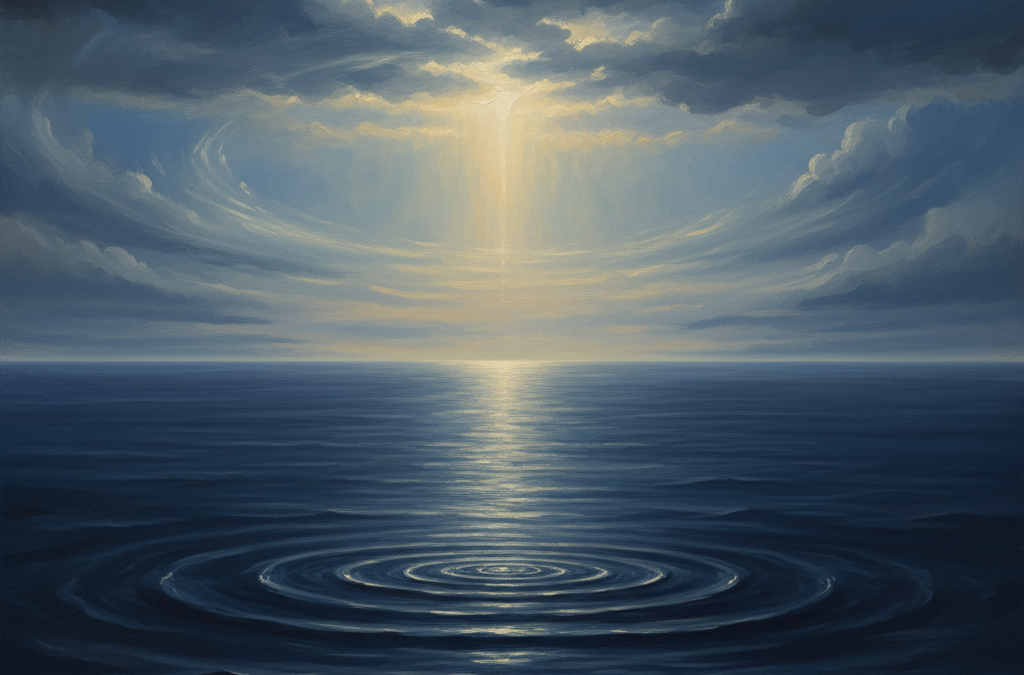
Most epic fantasy stories begin in the same emotional place: something precious has already been lost. The world is broken, the magic is fading, the gods are distant or dead, and whatever once held reality together has slipped into legend.
For instance, Middle‑earth opens in the long shadow of greater ages. The Wheel of Time begins after a cataclysm so severe it reshaped the world itself. The Stormlight Archive drops readers into a setting haunted by repeated apocalypses, where history feels more like a warning than a promise. Modern fantasy, almost without exception, assumes that order is fragile and temporary, and that decay is the natural direction of things. In other words, modern fantasy sees only a fallen world.
Genesis 1 opens somewhere else entirely. It does not begin after the fall, after the war, or after the disaster. It begins before anything has gone wrong at all. Not before mystery or danger, but before corruption. Before death. Before sin. It opens not with heroes or villains, but with darkness, water, and a voice.
“In the beginning, God created the heavens and the earth. The earth was without form and void, and darkness was over the face of the deep” (Genesis 1:1–2, ESV).
To a fantasy‑trained imagination, this sounds like the beginning of a threat. In pagan myths, darkness and the deep are rarely passive. Chaos is usually divine, and the sea is often alive, hostile, or sacred. Creation happens only after a god fights another god, kills a monster, or tears the world out of a rival’s body. Ancient Near Eastern creation epics like the Enuma Elish follow this pattern, portraying the world as the aftermath of divine conflict. Before this framework even existed, Genesis stands in striking contrast to this pattern. The darkness is not a god. The waters are not alive. The deep is present, but it is not rival or ruler.
A Creator Who Does Not Struggle
Instead, the text tells us that “the Spirit of God was hovering over the face of the waters” (Genesis 1:2). There is no sense of urgency here, no struggle for control. God is already present, already above, already unthreatened. From the very first verses, Genesis begins reshaping the pagan mind, teaching it to see the world not as a battlefield between equal powers, but as a creation already under the authority of its Maker. This is where True Fantasy begins—not by romanticizing chaos, but by revealing the God who stands over it.
What follows only deepens this contrast. When God creates, He does not fight, negotiate, or sacrifice anything of Himself. He speaks. “And God said, ‘Let there be light,’ and there was light” (Genesis 1:3). For readers shaped by fantasy, this is almost unsettling in its simplicity. There is no cost to God’s power, no visible limitation, no opposing force testing His strength. Reality responds because it belongs to Him. Words are not spells meant to manipulate hidden laws of the universe; they are expressions of authority. God does not discover how creation works. He defines how it will work.
This is one of the ways Genesis quietly reshapes assumptions about power and origin. Most fantasy worlds, ancient and modern, are built on the idea that power must be earned through conflict and that even gods are constrained by rules they did not create. Genesis presents a God who does not share His category. He is not the strongest being in a crowded universe; He is the source of the universe itself. The story establishes this so early that it removes any suspense about who ultimately rules the world. The drama of Scripture will never come from God’s weakness, but from humanity’s response to His goodness.
Naming the World Into Meaning
One of the most easily overlooked, yet deeply powerful, features of Genesis 1 is the repeated act of naming. God calls the light Day and the darkness Night. He names the sky and the land, the seas and the seasons. In fantasy literature, names often carry weight because they reveal essence or grant control. Genesis uses that same instinct, but grounds it in authority rather than mysticism. Naming is not about unlocking hidden power; it is about placing things where they belong. By naming, God gives structure to reality. Boundaries form, roles emerge, and meaning takes shape.
What makes this even more striking is that God later invites humanity into this same act. In Genesis 2, Adam names the animals, participating in the ordering of creation rather than merely inhabiting it (Genesis 2:19). From a storytelling perspective, this is the moment when humans are revealed not as background characters, but as entrusted participants. They are not divine, but they are image‑bearers (Genesis 1:27), given the dignity of shaping the world under God’s authority (Genesis 2:15 and Psalm 8:5-6). This is not escapist fantasy; it is vocational. True Fantasy insists that imagination is not meant to detach us from reality, but to help us see our place within God’s story more clearly.
Another recurring pattern in Genesis 1 is separation. Light is separated from darkness, waters from waters, sea from land. In modern storytelling, separation often carries negative connotations, associated with division or exclusion. Genesis treats separation as a creative act, one that makes life possible. Without distinction, nothing can flourish. Without boundaries, chaos returns. “And God saw that it was good” (Genesis 1:10) is not a moral stamp placed on power, but on order.
This stands in sharp contrast to pagan worldviews that blur the line between creator and creation, or treat chaos as something sacred. Genesis insists that order is not oppressive. It is protective. It is what allows life to grow without being consumed. Fantasy readers instinctively understand this when they imagine realms, borders, and domains, even if they do not always recognize how deeply biblical that instinct is.
The Golden Age That Actually Existed
Perhaps the most surprising thing Genesis offers, especially to readers accustomed to darker fantasy, is a world that is genuinely good. Not good in a fragile or temporary sense, but good in a fundamental way. There are no monsters lurking in the shadows, no hidden corruption beneath the surface, no sense that disaster is inevitable. When God finishes His work, Scripture tells us that He looks at everything He has made and declares it “very good” (Genesis 1:31). Evil is not original. Darkness is not ultimate. Sin is an intruder, not a co‑author of the world.
This matters because it shapes hope. Most fantasy longs for a golden age that may never have existed. Genesis presents a goodness that is not imagined or symbolic, but foundational to reality itself, and that its loss was not the end of the story. The ache readers feel for restoration is not imaginary either; it is a memory written into the human heart.
Into this good world, God places humanity and gives it authority. “Let us make man in our image, after our likeness. And let them have dominion…” (Genesis 1:26). Humans are not the strongest creatures in the story, nor are they magical or completely immortal. What makes them dangerous, in the narrative sense, is that they resemble God and are entrusted with responsibility. From this point on, the tension of Scripture will not be whether the world can survive, but whether image‑bearers will live in faithfulness.
The God Who Rests
Genesis 1 closes not with spectacle, but with rest. “On the seventh day God finished his work… and he rested” (Genesis 2:2). This rest is not exhaustion, but completion. The world does not teeter on the edge of collapse, requiring constant divine intervention. It is stable because God made it so. In a genre filled with anxious gods and fragile systems, this portrait of a Creator who rests is quietly radical. It invites trust rather than fear.
The New Testament makes it clear that Genesis 1 was never meant to stand alone. The God who speaks, names, separates, blesses, and rests does not remain distant from His creation. John deliberately echoes its opening words when he writes, “In the beginning was the Word… All things were made through him” (John 1:1–3). Paul tells us that Christ is “the image of the invisible God” and that “in him all things hold together” (Colossians 1:15–17). The God who spoke light into existence is the same God who stepped into creation in the person of Jesus Christ. He does not undo creation; He fulfills it. He brings light into darkness, calms the waters of chaos, and begins the work of restoration toward that which Genesis established.
This is where True Fantasy finds its purpose. It is not about escaping into imaginary worlds, but about learning to see this world as God reveals it. Pagan fantasy trains us to fear chaos, distrust authority, and assume that power corrupts by necessity. Genesis retrains the imagination to recognize a Creator whose power is good, whose order is life‑giving, and whose presence is not distant.
Is Genesis 1 the Greatest Fantasy Opening?
Genesis 1 ultimately asks whether we are willing to let our imaginations be changed. Are we willing to believe that boundaries are gifts, that authority can be exercised in love, and that the story did not begin in tragedy? Are we willing to step into God’s supernatural story, not as passive observers, but as image‑bearers called to reflect Him?
From its very first chapter, Scripture points us toward Jesus, the true image of God, through Whom creation began and through Whom it will be restored. The invitation is not merely to read the story, but to enter it, allowing God to reshape how we see the world, ourselves, and the meaning of True Fantasy.
Keep Reading: Chapter 4: The Waters Before the Light
IF a person is willing to let the imagination be changed and willing to believe that boundaries are gifts etc., then that person was a so called scoffer whose heart was transformed by God’s word. If not, then that person can yet still be transformed by the hearing of the word, until the willing to believe starts…with ignition from the Holy Spirit. Onward…