
A philosopher once told a theologian, “No one has ever proven that God actually exists.”
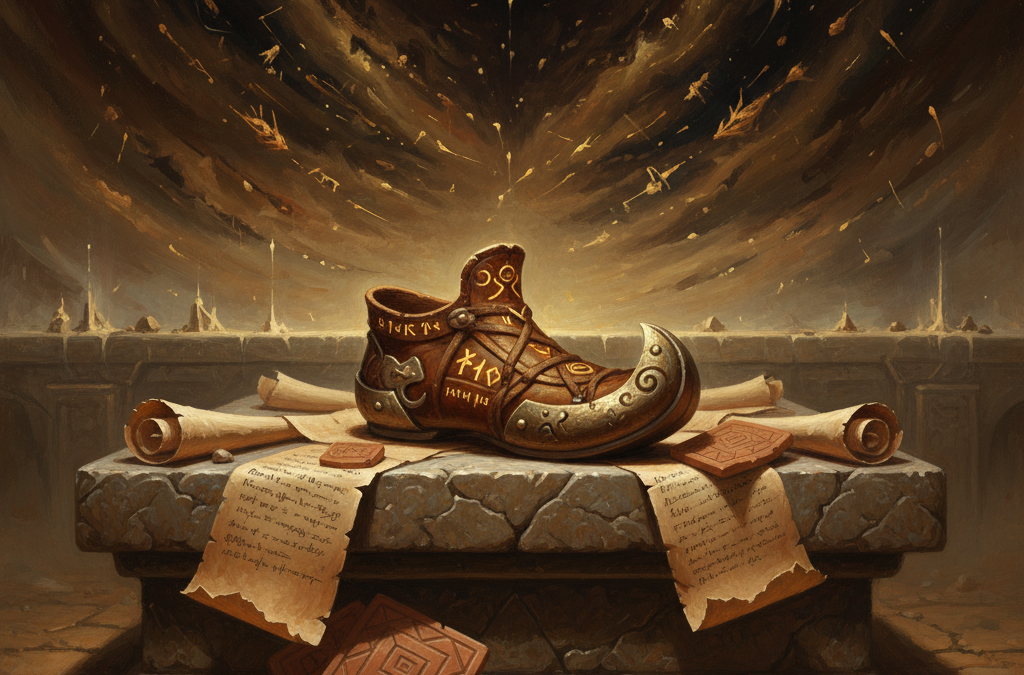
The theologian paused, then removed his shoe and placed it on the table.
“You’re mistaken,” he said. “This shoe is proof that God exists.”
The philosopher smiled. “Explain.”
The theologian continued, “When we ask why anything exists — even something as ordinary as this shoe — there are only a handful of possible explanations at the most basic level. Philosophically speaking, every explanation for existence ultimately reduces to one of these:
- The object is an illusion.
- The object brought itself into existence.
- The object is self-existent — it has always existed.
- The object was brought into existence by something self-existent.”
The philosopher agreed that these categories fairly represented the options.
“Now,” the theologian continued, “we can dismiss the first option. The shoe is not an illusion. It has measurable properties and can affect other objects. If I throw it, you will feel it.”
“Agreed.”
“Second, the shoe cannot have created itself. For something to create itself, it would need to exist before it existed — which is a contradiction.”
The philosopher nodded.
“That leaves two remaining possibilities: either this shoe is self-existent — eternal and necessary — or it was created by something that is.”
The philosopher admitted that the shoe is clearly not self-existent. It decays. It wears out. It is contingent.
“So we are left with this,” the theologian concluded. “If something exists that is not self-existent, then something else must be. And that self-existent reality cannot be material, because all material things are contingent and dependent. At some point, explanation must terminate in a reality that exists by necessity rather than by cause.”
The theologian then looked at the philosopher.
“That necessary, self-existent reality is what we call God.”*
With that settled, another question arises: How did this self-existent God create?
Since nothing material is self-existent, there had to be a starting point. The Bible starts: “In the beginning…” which is pretty clear. There was a starting point to what we see in front of us. But how do we know what occurred at the beginning? After all, people weren’t around when the world began. In fact, there isn’t a creation story in existence that says humans were there “in the very beginning.”
Even with evolution, humans didn’t come into being for millions, if not billions, of years after the initial event. So how can we know what happened?
Many today look to science for answers about our origins. Through observation, experimentation, and careful reasoning, science has uncovered remarkable insights into how the universe behaves. But science, by its very nature, studies processes within the universe—it examines what already exists. When it comes to the ultimate question of why anything exists at all, science can describe mechanisms, but it cannot supply the final explanation. At some point, every account of origins must step beyond measurement and tell a story about what was there at the beginning.
The reality is that every explanation we have for what occurred “in the beginning” is simply a story. Science may help us develop the story, but it is still a story. And there can be only one true story. We’ve already determined that God exists and that He had to be the creator of everything, which makes this story supernatural (as opposed to a purely natural story, which we’ve already determined is not possible). And we determined in the Introduction that a supernatural story that’s true can be classified as True Fantasy. But let’s not draw our conclusion too quickly. Let’s give all the creation stories an opportunity to prove their worth.
We can say with certainty that the world did come into existence somehow. And we can say with just as much certainty that there is only one actual way that it occurred. But this brings us to some serious questions.
- Do we already have access to the true story of creation?
- If we do, how do we figure out which one is the correct story?
- If we can discover the true story of what happened, what does that make all the rest of the stories?
In this case, it’s best to answer the questions in reverse order, as each one will help us answer the other questions. And it’s usually best to answer the easiest and most obvious questions first.
So the answer to question #3 is easy. If there is only one true story of how the world came into being, then the rest are just myths—false ideas that lead us to incorrect conclusions. If we could line up all the creation stories, how could we determine which one is true (question 2)?
Based on the method our theologian laid out at the beginning of this episode, it’s actually easier to prove which ones are not true. That’s because every myth starts with an impossibility.
To understand this, we have to look at the elements of a story and what makes it a myth. If we know these elements, we can quickly dispatch any story that fits into this category.
In high school language arts classes, we learned that myths have three structural elements: binary oppositions, mythemes (pronounced “MITH-eems”), and primary messages. Binary oppositions refer to two contrasting concepts, such as good and evil or light and darkness, that build the fundamental structure of the myth. Mythemes are the smaller aspects of the story, the stripped-down components that flesh out the myth’s structure. Finally, the primary messages are determined by the motives of the myth’s creator and what the reader should learn.
It is in the binary opposition that creation stories (including evolution) reveal their false idea. That’s because every creation myth has the binary opposition of chaos versus order.
Most rational minds know that our world has some order (which is why we can have science), and man’s actions can either (a) continue this order and build on it or (b) disturb it and create chaos. Every creation story (except one) assumes that since we have order now, there must have been chaos “in the beginning,” and somehow this chaos brought order.
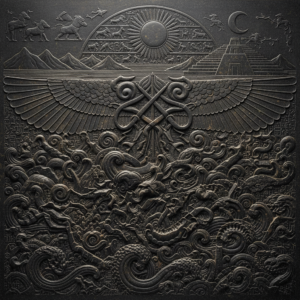 For instance, one of the most popular creation myths that embodies the chaos to order theme is the Enuma Elish, an ancient Babylonian narrative. This myth describes the emergence of the world from primordial chaos, represented by the saltwater goddess Tiamat and the freshwater god Apsu. In the beginning, these two chaotic forces existed together, resulting in a turbulent and formless state.
As the story unfolds, the younger gods, born from Tiamat and Apsu, become frustrated with their chaotic existence. They conspire to defeat Apsu, which leads to his demise. However, Tiamat, seeking revenge, creates monstrous beings to battle the younger gods. This sets the stage for a climactic conflict between order and chaos.
The hero, Marduk, ultimately confronts Tiamat, wielding powerful weapons gifted by the other gods. After a fierce battle, Marduk defeats Tiamat, splitting her body to create the heavens and the earth. This act establishes order from chaos, as Marduk becomes the king of the gods.
The Enuma Elish, while a fascinating cultural artifact, is not considered true in a historical or scientific sense because it is a mythological narrative rather than a factual account of creation. Myths often reflect the beliefs, values, and understanding of the world held by a particular culture at a specific time, serving more as allegorical stories than literal truths. The chaotic primordial forces and divine battles depicted in the Enuma Elish symbolize human experiences and existential questions rather than actual events. Thus, while the myth holds cultural significance and offers insights into the ancient Babylonian worldview, it deals with impossibilities.
Across cultures and centuries, creation stories share a striking pattern. Whether framed as warring deities, primordial waters, impersonal matter, or cosmic energy, they begin with something already there. Something precedes order. Something unexplained stands at the beginning. That “something” may be called chaos, matter, energy, or fluctuation—but it functions the same way: it is treated as the starting point.
The question is not whether complex structures can develop over time. The deeper question is this: Why does anything exist at all? And why does what exists display consistent order, rational structure, and discoverable laws? To say that order gradually emerged from impersonal beginnings does not eliminate the need for explanation—it relocates it. Why should impersonal reality give rise to personal beings? Why should mind emerge from non-mind? Why should rational laws arise from what is fundamentally non-rational?
Genesis answers differently. It does not begin with impersonal potential. It begins with a personal, self-existent Being whose nature accounts for order, purpose, and intelligibility from the start.
The real question isn’t whether disorder came before order. The real question is whether whatever was at the beginning can explain what we see now. If the starting point is impersonal, how do we get persons? If it is mindless, how do we get minds? If it has no purpose, where does purpose come from? The beginning must be great enough to account for what follows.
That’s where the Bible creation story becomes superior—and the only possible true story (i.e., True Fantasy). But the difference is deeper than superiority. Every other creation story begins within the system it is trying to explain—chaotic forces, rival gods, impersonal matter, or preexisting energy. Genesis does not. It begins outside the system altogether: “In the beginning, God.” Before time, before matter, before conflict, before potential, there is a self-existent Being. God is not one force among others, not a character emerging from a cosmic struggle. He is the source of being itself. Creation is not the rearranging of something already there. It is the result of a personal, intentional act of speech. That places Genesis in a category of its own.
The Bible starts with “In the beginning, God….” That statement tells us two things: At the beginning of time, there was only one entity: God. And it tells us that, according to our introductory story, God was and is self-existent. He always was, and He will always be.
The Bible’s account is the only creation story that doesn’t start with chaos. There was only God, and, based on His character, He created an ordered world. As we know, God provides commentary as He creates, calling each element of His creation “good.”
When God says creation is “good,” everything He created was designed with purpose and is inherently good according to His standards, reflecting His goodness (His order) and functioning as intended in its original state. Essentially, it signifies that creation is perfectly ordered and without flaw as God intended it to be, as stated in Genesis 1:31, where God declares his creation “very good.”
Furthermore, God didn’t create order out of chaos. He created an ordered world out of nothing but Himself. Before time began, there was nothing else but God. Hebrews 11:3 states it this way: “By faith we understand that the universe was created by the word of God, so that what is seen was not made out of things that are visible.”
This statement is a critical lynchpin for True Fantasy. It starts by saying that everything we see (the earth, everything on the earth, and everything in the heavens) was created by the word of God. This self-existent Being created everything simply by speaking. The power to create came from within Him, and His spoken word brought all things into existence.
Then, the writer of Hebrews makes an astounding pronouncement: “what is seen was not made out of things that are visible.” God didn’t start with a chaotic world. He started with just Himself. The invisible God spoke and formed the visible world.
Remember in the Introduction when we detailed how the word “fantasy” comes from the Greek word phantazein, which means “to make visible”? Well, in this verse, the writer doesn’t use this word. He uses a similar word for “visible”—phainomenon, meaning “that which appears” or “something that can be seen,” referring to an observable event or phenomenon. The Invisible created the visible. This word used in Hebrew comes from the root word “phainein” which means “to appear” or “become visible.” It is the same root word of “phantazein.”
In other words, the English words “fantasy” and “phenomenon” come from the same root word in Greek. Together, they emphasize that the invisible God created a visible world out of nothing but His spoken word. The power of God’s word is unmatched. It is phenomenal. It is supernatural. And it makes a fantastic story that will only get more exciting!
Don’t miss the big point: Hebrews 11 tells us that everything written from Genesis 1:1 onward is truly phenomenal. Or, said another way, it is True Fantasy! And this True Fantasy is the very basis of our faith. It is that important!
It is the true story of God creating a “good,” ordered, and perfect world that accurately reflects Him and who He is. He created it out of Himself, not out of chaos. Oh, chaos enters the world. But that’s a story for another day.
This truly fantastic story was designed to catch the attention (i.e., capture the minds) of humans who need to see the dawn of time (before they were created), their origin story, and their need for God.
Based on the logical, philosophical, and theological realities we’ve discussed, the biblical account of creation is the only supernatural, “fantastical,” and phenomenal story that can be true. That makes all the other stories, including evolution, myths. Yes, some people find the biblical creation story hard to believe. C.S. Lewis certainly did at first. But the evidence clearly shows it is, in fact, True Fantasy!
In our next episode, we’ll look at the foundational elements of True Fantasy as we continue to look at God’s ordered creation.
* Adapted from a story told by R.C. Sproul on Ligonier.org.
Keep Reading: Chapter 3: Before the World Had Heroes