
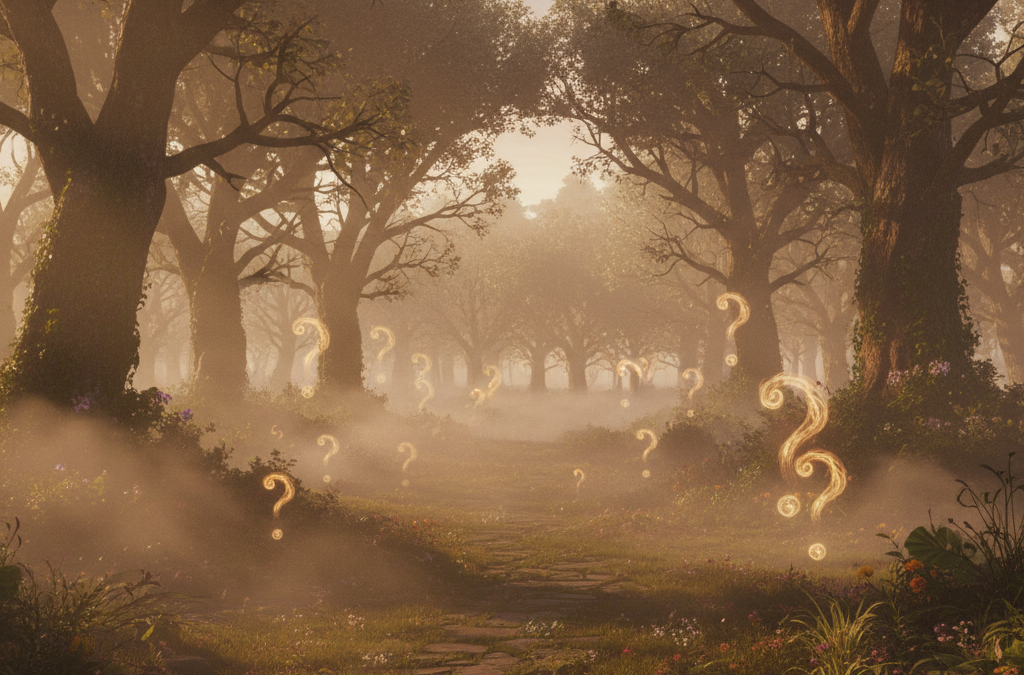
In many great fantasy stories, the real battle is not fought with swords, but with ideas. In The Lord of the Rings, the Ring whispers power and bends the mind before it ever controls the hand. In Harry Potter, dark forces twist truth and rewrite history to gain control. In The Chronicles of Narnia, lies reshape how characters see Aslan and themselves. These stories show us something familiar: before kingdoms fall, minds are captured.
Genesis 3 presents the most important battle of all, and it begins the same way. Not with violence. Not with armies. But with a question.
“Did God really say…?”
From a True Fantasy perspective, this moment is the collision of two realities. God has already spoken the world into existence. His Word created light, order, beauty, and life. His speech shaped truth itself. Everything in the garden stands on the foundation of what He has said.
Then another voice enters.
The serpent does not attack God’s creation directly. He challenges God’s words. His question is subtle, but it bends reality. It shifts attention away from what God generously provided and toward what seems restricted. It suggests that God may not be fully good, or fully truthful. The world itself has not changed, but the way it is viewed begins to warp.
This is the birth of a competing worldview. In that instant, the garden did not yet tremble — but its harmony had already been wounded.
The serpent offers an alternate story about God, about freedom, and about wisdom. In that moment, purity and distortion collide. One vision is rooted in trust and glory directed toward the Creator. The other is rooted in suspicion and glory redirected toward the self. The battle is not external first; it is internal. It takes place in the mind.
This is why Genesis 3 matters so deeply. The fall of humanity begins with a question because questions shape perception. Perception shapes belief. Belief shapes action. When distortion wins in the mind, sin follows in the world. And once sin follows, nothing in the visible world remains untouched.
The serpent is described as “crafty,” which means clever or shrewd. His power lies in how he uses language. He does not create anything new. He rearranges meaning. He takes the very gift of language, given by the God who spoke all things into existence, and uses it to undermine trust in that same God.
This is a war of words.
The serpent’s question is not just about a tree. It is about the character of God. If God can be seen as withholding or deceptive, then the foundation of reality begins to crack. A distorted view of God becomes the seedbed for every other distorted thought.
Later in the chapter, God asks questions of His own. “Where are you?” and “Who told you…?” These questions are not asked because He lacks knowledge. They are asked to expose what has taken root in the human mind. God’s questions are redemptive. They uncover distortion and call it into the light. The serpent’s question hides distortion beneath a mask of reason.
From this point forward, Scripture continues this pattern. Prophets confront false thinking with truth. Jesus asks piercing questions that reveal what people truly believe. The gospel itself corrects the deepest distortion: that we can define good and evil apart from God. The story of the Bible is the story of reality breaking into fantasy, of truth confronting lies, of God reshaping minds through His Word.
In every age, the battle remains the same. Competing visions of God compete for our trust. One worldview exalts the self and treats God as small or unnecessary. The other exalts God and places the self in humble dependence. When distortion wins, sin follows. When truth wins, righteousness grows.
Genesis 3 shows us that the most important questions in history are not about politics or power, but about who God is and whether His Word can be trusted. Those questions shape every culture, every philosophy, and every life. They are the most important questions of any story ever told because they determine which reality we live in: the one God spoke into existence, or the one we attempt to invent.
True Fantasy Reflection
Every day, you are asking questions, even if you do not say them out loud. Is God really good? Can I trust what He has said? Would I be better off defining truth for myself? If your view of God is distorted, your other thoughts and actions will slowly bend in the same direction. A small shift in how you see Him can reshape your entire worldview.
So consider the questions you entertain and the questions you ask others. Are they destructive, quietly planting doubt and suspicion? Or are they redemptive, drawing minds back toward truth? The war of words did not end in the garden. It continues in every conversation and every thought. The question is not whether you are part of the battle, but which reality your words are building.