
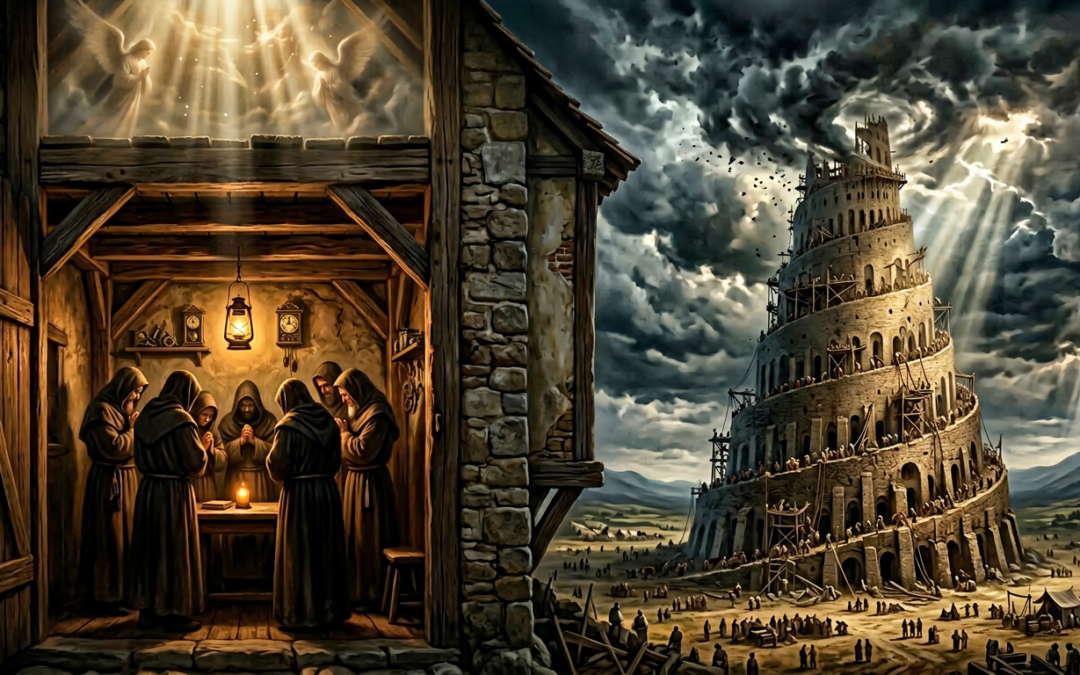
Behind a false wall in a quiet watchmaker’s house in Haarlem, six people once stood in complete silence while soldiers searched the rooms. The hidden space was small and close, built just inches from discovery.
It existed because Corrie ten Boom and her family believed a verse from the Psalms was not just poetry, but truth: “Thou art my hiding place and my shield” (Psalm 119:114). They trusted that God was a refuge, and they used their skills to shape wood and plaster into a living picture of that promise.
That hidden room was born from imagination. But it was not imagination as escape. It was imagination guided by faith. The ten Booms pictured a world in which God’s kingdom was more real than fear. They imagined obedience when others imagined survival. Their faith took form in boards and nails.
The Bible tells another story about imagination. In Genesis 11, people gathered on a plain and said, “Let us build us a city and a tower, whose top may reach unto heaven.” They imagined greatness, safety, and fame. They believed they could rise high enough to secure their own future. The tower was also built with skill and vision, but it was driven by pride rather than trust. One imagination built a hiding place under God. The other built a tower without Him.
The difference is not creativity. It is direction.
Imagination itself is not the problem. In fact, imagination begins with God. Before there were mountains or oceans or starlight, there was the mind of God. “In the beginning God created the heavens and the earth” (Genesis 1:1). Creation shows us something about His nature. He did not make a gray and empty world. He filled it with color, rhythm, beauty, and life. He shaped galaxies that stretch beyond our sight and tiny flowers that bloom for a single day. “The heavens declare the glory of God” (Psalm 19:1). Every sunrise is proof that God delights in beauty.
When we speak of imagination, we often think of stories about dragons, distant kingdoms, or unseen realms. Yet the Bible itself is filled with images that are True Fantasy. A bush that burns without turning to ash. A sea that opens a path through its depths. Wheels within wheels blazing with light. A throne surrounded by living creatures crying, “Holy, holy, holy” (Revelation 4:8). A city of gold with gates of pearl where tears are wiped away (Revelation 21:21, 4). These are not inventions of human minds. They are glimpses of God’s reality. What we call fantasy may simply be our attempt to grasp the wonder of what He has already made.
Human beings create stories because we are made in God’s image (Genesis 1:27). We imagine heroes because we long for rescue. We dream of evil defeated because we know the world is broken. We tell tales of lost kingdoms restored because our hearts ache for home. These longings are not accidents. They echo the larger story God is telling. Scripture says, “Eye hath not seen, nor ear heard… the things which God hath prepared for them that love him” (1 Corinthians 2:9). Even our best stories fall short of what He has planned.
But imagination can turn in the wrong direction. Genesis 6:5 warns that “every imagination of the thoughts of his heart was only evil continually.” When imagination separates from truth, it can twist into something dangerous. The tower of Babel was not built because people lacked creativity. It was built because they wanted glory apart from God.
Throughout history, leaders have imagined perfect societies and powerful empires, promising heaven on earth while ignoring heaven’s King. When imagination exalts itself against the knowledge of God, it becomes destructive. Paul writes that we must cast down “imaginations, and every high thing that exalteth itself against the knowledge of God” (2 Corinthians 10:5). The problem is not that we imagine too much, but that we imagine without Him.
This is why the story of Corrie ten Boom matters. Her family’s imagination did not try to replace God’s rule. It rested in it. They believed that obedience to Christ was more solid than any government. Their hidden room was small, but it reflected a greater reality. They trusted the God who parts seas and raises the dead. Their imagination moved upward, shaped by Scripture and grounded in love.
True Fantasy, then, is not about escaping the real world. It is about seeing the real world more clearly. It is about understanding that the greatest story ever told is not one we invented. It is the story of a God who stepped into His own creation. “The Word was made flesh, and dwelt among us” (John 1:14). If someone wrote that as fiction, we might call it too bold to believe. Yet Christianity declares that it happened. The deepest longing of every heroic tale finds its answer in Christ, who faced evil, bore suffering, and rose again to restore what was lost.
When we look at the hiding place and the tower side by side, we see two paths for imagination. One seeks to climb upward by human strength. The other kneels and builds under God’s shelter. One tries to control the future. The other trusts the Author of it.
God’s own imagination is not wild or reckless. It is vast, holy, and life-giving. He speaks worlds into being and writes redemption into history. When our imagination follows His Word, it becomes a gift that lifts us. It helps us picture forgiveness when anger feels easier. It helps us see hope when darkness seems thick. It allows us to act with courage because we believe a greater story is unfolding.
True Fantasy Reflection
Take a moment to consider what shapes your imagination. The stories you love, the fears you rehearse, the futures you picture all guide your steps. Scripture does not ask you to stop imagining. It invites you to imagine rightly. Let the Word of God fill your mind with images of who He is: a Shepherd who leads, a Father who welcomes, a King who reigns, a Savior who rescues. As you read the Bible, picture its promises as living realities. See the empty tomb. Hear the songs around the throne. Envision the day when every tear is wiped away.
Ask yourself whether your imagination is building a tower or a hiding place. Is it striving for control, or resting in trust? When imagination is guided by Scripture, it becomes a window into True Fantasy, the kind that is not make-believe but anchored in eternal truth. The God who imagined the stars into existence invites you to dream under His light. Let your imagination rise toward Him, and it will lead you not away from reality, but deeper into it.