
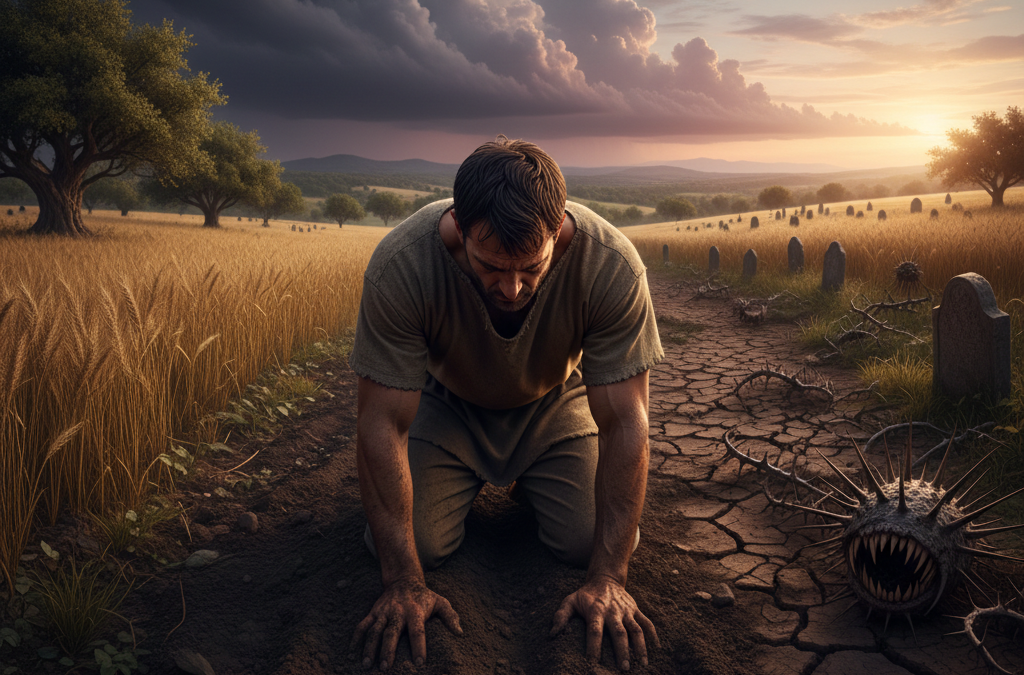
The voice that once blessed now turns and names the cost.
In the garden, God had spoken light into darkness and brought order out of chaos. He had shaped the man from dust and placed him in a world that answered gladly to his care. Trees gave fruit. The ground received seed. Work was not a burden, but a joy. Dominion was not force, but stewardship. The earth and the man lived together in quiet harmony.
Then silence entered where speech was needed.
The woman had been addressed. The serpent had been judged. Now the Lord turns to the man and says, “Because you have listened to the voice of your wife and have eaten from the tree about which I commanded you, ‘You must not eat from it,’ cursed is the ground because of you” (Genesis 3:17).
The words carry great weight. They do not explode in anger. They settle like a sentence that cannot be escaped.
The curse does not first fall on Adam’s body. It falls on the soil. The ground that once rose at God’s command now bears a wound because of the one who was formed from it. Adam came from dust, and now his sin draws the dust into judgment. The earth does not rebel on its own. It is pulled into the man’s fall because he was placed over it. He was made from the soil and appointed to tend it, so what touches him also touches the ground.
In the ancient stories of the nations, the earth often groans because the gods are at war or because the world was shaped through violence between rival powers. In those myths, the soil is unstable because the gods themselves are unstable. Genesis tells a very different story. The Creator is not divided. He is not fighting against equal forces. The ground is not wounded by divine conflict. It is wounded by human rebellion. The break runs through the heart of the man God formed. The problem is not matter. The problem is sin.
Paul later looks back on this moment and writes, “Through one man sin entered the world, and death through sin” (Romans 5:12). He does not say sin entered through a crowd or through humanity in a general way. He says it came through one man. The sentence in the garden was not private. It was representative. The weight placed on Adam did not rest on him alone. It pressed down on every son and daughter who would come from him.
This challenges the modern mind more than we like to admit. We often prefer to think of ourselves as independent, self-made people who are untouched by the choices of others. We want autonomy, not inheritance. Yet Scripture insists that we were never isolated individuals drifting through a neutral universe. We were represented. We were carried in the decision of another. Adam did not fall alone. He fell as the head of a race. Even the soil testifies that we belong to one another and that we are bound together under a covenant we did not create.
The soil would never feel the same again.
The Lord continues, “In toil you will eat of it all the days of your life. It will produce thorns and thistles for you” (Genesis 3:17–18). The ground that once welcomed Adam’s hand now pushes back against him. What had been a field of promise becomes a field of effort. Sweat replaces ease. Strain replaces song. The earth still yields, but now it yields with resistance.
This does not mean the soil has become evil. Dirt is still dirt, and God had already called it good before sin touched it. But now the ground shares the story of the man. It bears the scar of his choice. Humanity and the earth are bound together in both blessing and burden.
There is something fitting about this. Adam was formed from the dust of the ground. He was never meant to float above creation or escape it. He was given dominion, not detachment. When he turned away from the Word that gave him life, the fracture reached into the very material from which he was made.
The tension rises slowly in the text, like a storm gathering on the horizon. The garden does not vanish at once. The trees do not fall in a single crash. Instead, the future changes. Every sunrise will now carry effort. Every harvest will require sweat. The rhythm of work will be marked by resistance.
Then the Lord speaks again, and this time the sentence reaches Adam’s own body: “By the sweat of your brow you will eat your food until you return to the ground, since from it you were taken; for dust you are and to dust you will return” (Genesis 3:19). This sentence was not only sorrow. It was condemnation. Dust, which had once been the raw material of wonder, now becomes the measure of mortality.
The man who stood upright in the garden will one day lie down in the soil. The breath that gave life to the dust will depart. The body will return to the earth from which it came.
Many ancient and modern philosophies treat death as release, as though the soul is finally slipping free from the prison of the body. Matter is seen as lower, and spirit is seen as higher. Even now, people often speak of death as a kind of awakening or a return to the universe. But Genesis does not allow that story. Dust is not the problem. Sin is. Returning to the soil is not enlightenment. It is judgment. The body is not a cage to escape, but a gift that has been fractured. The weight of the soil is not an illusion. It is a consequence.
Paul calls Adam “the first man” and says, “The first man was of the dust of the earth” (1 Corinthians 15:47). He is not only describing Adam’s origin. He is describing our inheritance. Paul continues, “As was the earthly man, so are those who are of the earth” (1 Corinthians 15:48). What Adam became under the sentence of death, his children share.
This is the full weight of headship. Adam did not merely influence humanity. He stood for it. When he fell, we fell in him. When the ground was cursed because of him, it was also cursed for us. The soil beneath our feet carries the memory of that moment.
Paul speaks plainly when he writes, “By the trespass of the one man, death reigned through that one man” (Romans 5:17). Death is not just an accident of biology. It is a reign. It rules, claims, and moves through generations like an unbroken chain.
Graves rise from the ground in every land. Cemeteries spread across hills and valleys. The dust receives kings and farmers, children and elders. No strength of body or sharpness of mind can finally resist the pull of the soil. The sentence spoken in Eden still echoes.
Yet even in judgment, there is a strange mercy. The ground is cursed, but it is not abandoned. The man will labor, but he will still eat. The soil will resist, but it will still yield. God does not unmake the earth. He binds Himself to a wounded creation and continues the story within it.
The soil beneath our feet is not random matter in a meaningless universe. It is also not divine energy filled with hidden power. It is cursed ground under the authority of a holy God. It carries both judgment and promise. It groans, but it does not rule. It waits, but it does not decide the end of the story.
The New Testament does not soften Adam’s responsibility. It deepens it. Paul writes, “For since death came through a man, the resurrection of the dead comes also through a man” (1 Corinthians 15:21). The contrast only works if the first claim is real. Death came through a man. Death came through Adam.
The weight of the soil is not merely physical. It is covenantal. Every time a seed is pressed into the ground and watered with sweat, it testifies to both design and distortion. We were made to cultivate the earth, but not like this. We were made to rule, but not under the shadow of the grave.
In Romans 8, Paul says, “The creation was subjected to frustration, not by its own choice, but by the will of the one who subjected it” (Romans 8:20). The earth did not volunteer for this burden. It was drawn into it because of the one set over it. Paul also says that “the whole creation has been groaning as in the pains of childbirth right up to the present time” (Romans 8:22).
The soil groans. Fields erode. Storms rage. Drought cracks the ground. The natural world bears beauty and brokenness side by side. It still declares the glory of God, as Psalm 19 says, but it also sighs beneath a weight it was never meant to carry.
And we groan with it. Our bodies age. Our strength fades. The dust reminds us daily that we are formed and finite. We clean it from our homes, wipe it from our shelves, and brush it from our clothes, yet still it returns. It clings to us because we belong to it.
Paul says, “For as in Adam all die” (1 Corinthians 15:22). There is no softer way to say it. The sentence spoken to one man flows through every family line. The first breath we take begins a journey that ends in the soil.
This is darker than we like to admit. Modern life may wrap death in quiet rooms and polished wood, but it cannot erase death. We feel the weight of the soil at funerals and hospital beds, in diagnoses and headlines. The ground waits patiently. It always does.
And yet Paul does not end with Adam. He writes, “The first man Adam became a living being”; the last Adam, a life-giving spirit” (1 Corinthians 15:45). The language is careful. The first man received life. The last Adam gives it. The first man came from dust. The second man came from heaven.
The Lord who spoke the curse does not withdraw from the ground. He will walk upon it. He will kneel in its dust. He will take soil into His own lungs and feel its grit on His skin. The sentence does not drive Him away from creation. It sets the stage for Him to enter it more deeply than anyone expected.
The soil that carries the curse also becomes the stage of redemption. The Second Adam does not avoid the ground. He is buried within it. The dust that claimed the first man receives the body of the Second. The weight of the soil presses down once more, this time upon the One who had no sin of His own.
Even here, the hope is restrained. The curse is not erased in a single breath. We still labor. We still sweat. We still bury our dead. The dominion of the dust has been broken at its root, but its shadow still lingers over our days.
Paul speaks of bearing images when he writes, “Just as we have borne the image of the earthly man, so shall we bear the image of the man of heaven” (1 Corinthians 15:49). For now, we carry the marks of Adam. We feel the pull of the soil in our bones. We live east of Eden, working ground that resists our touch.
The weight of the soil reminds us that we are not self-made and not self-sustaining. It humbles us and presses us low. It teaches us that autonomy is an illusion and that life is a gift.
In the garden, Adam reached for wisdom apart from the Word. In the world that followed, every grave whispers the cost of that reach. The earth does not mock us. It receives us, but its embrace is cold.
Still, the story has not ended in dust.
The same God who formed the man from the ground has not abandoned His creation. The soil that bears the curse also carries promise. Seeds still rise. Fields still bloom. Bread still comes from grain. Even under judgment, mercy works quietly through dirt.
The weight remains, but it is no longer without meaning. We labor in hope. We bury in hope. We walk on ground that groans, yet we listen for something more. The sentence spoken to Adam explains the ache in our bodies and the struggle in our work. It tells us why the soil feels heavy in our hands, but it also prepares us to long for the day when dust will not have the final word.
For now, we live between promise and fulfillment, between curse and renewal. The ground beneath us carries both memory and expectation. It reminds us that we are dust, and it teaches us to look beyond dust for life.
The weight of the soil presses down, but it does not crush the promise.