
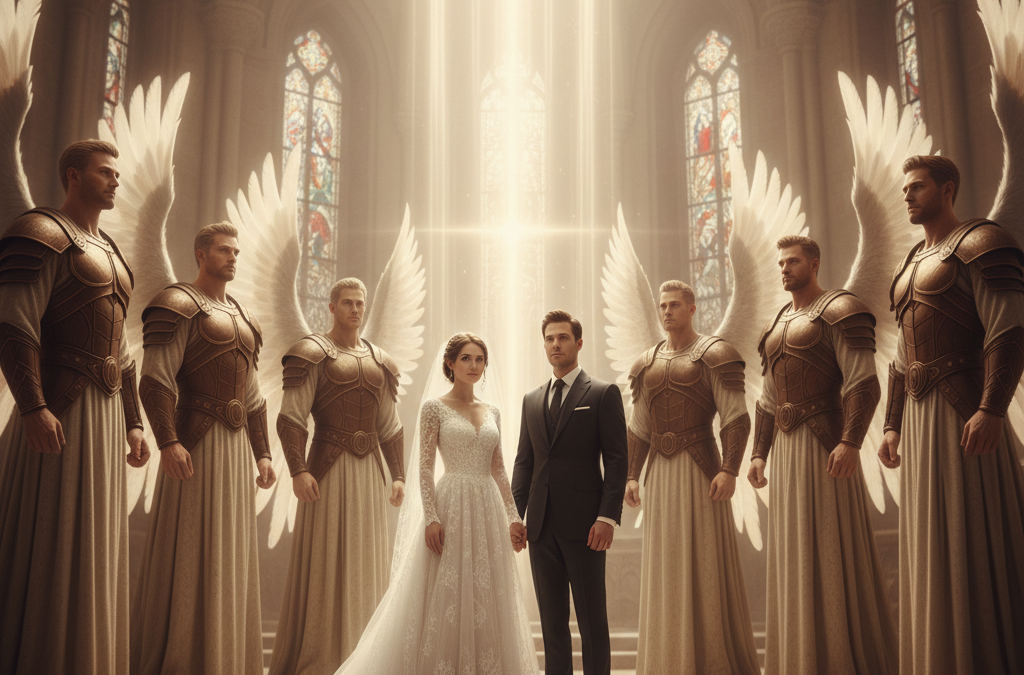
Genesis 2:1 declares, “Thus the heavens and the earth were finished, and all the host of them.” That final phrase—“all the host”—opens a window into a vast and largely unseen dimension of creation. Throughout Scripture, the word “host” can refer to armies or multitudes, and often it points to the heavenly host: the angels. By the end of the sixth day, not only were land, sea, plants, animals, and humanity complete, but the invisible realm was also populated. Heaven had its inhabitants as surely as earth had its own.
Exodus 20:11 reinforces this comprehensive scope: “In six days the Lord made heaven and earth, the sea, and all that is in them.” All that is in them includes not only galaxies and oceans but also the spiritual beings who dwell in the heavenly places. Colossians 1:16 brings this into even sharper focus: “By him all things were created, in heaven and on earth, visible and invisible, whether thrones or dominions or rulers or authorities—all things were created through him and for him.” Angels, in all their ranks and radiance, are created realities. They are not eternal rivals to God, nor independent sources of power. They exist through Christ and for Christ.
During those seven days of creation, there was no rebellion, no fracture in the unseen realm. Genesis 1 concludes with the sweeping declaration: “God saw everything that he had made, and behold, it was very good.” Everything means everything. The visible world and the invisible host stood together in harmony under God’s rule. Whatever later rebellion involving Satan had not yet taken place. Creation week was unified, ordered, and radiant with goodness. This was His glory on full display.
Job 38:7 gives us a poetic glimpse into that primal joy. When God laid the foundations of the earth, “the morning stars sang together, and all the sons of God shouted for joy.” The heavenly beings celebrated as the world came into existence. They rejoiced at the forming of mountains and seas, at the spreading of the skies, and ultimately at the creation of humanity. The unseen realm was not passive; it was alive with worship.
From a True Fantasy perspective, the scene is breathtaking. The heavens blaze with light. Spiritual beings sing in exultation. The earth unfolds in layered beauty and order. At the center of it all, God stoops to form a man from the dust and breathes into him the breath of life. The party of creation reaches its crescendo—not with the unveiling of an archangel, but with the animation of a human being.
Here, however, a profound tension emerges: angels are glorious, yet they are not the climax of Genesis 1–2.
We are naturally fascinated by angels—their power, brilliance, and speed. Revelation 5:11 describes them as “myriads of myriads and thousands of thousands” surrounding the throne. They are countless and mighty. When angels appear in Scripture, human beings often fall in fear. One angel can strike down armies; another can roll away a stone sealing a tomb. They are terrifying and beautiful, embodiments of divine strength and splendor.
Yet Genesis does not place them at the center of the story. The narrative weight falls instead on marriage.
After forming Adam, God declares that it is not good for the man to be alone. This is the first “not good” in all of Scripture. The solution is striking: God does not send an angelic companion from the heavenly host. Instead, He builds a woman from Adam’s side and personally brings her to him. Adam’s first recorded words are poetry: “This at last is bone of my bones and flesh of my flesh.” The creation account then culminates in the covenant declaration: “Therefore a man shall leave his father and his mother and hold fast to his wife, and they shall become one flesh.” The chapter closes with nakedness without shame, unity without rivalry, and authority without domination.
Marriage, not angels, is the earthly climax of creation.
This creates a holy tension. Angels are dazzling and powerful, but they are not image-bearers in the same embodied, covenantal way humanity is. They do not called to become one flesh. They are not commanded to multiply and fill the earth with embodied reflections of God’s image. Their glory is real, but it is not structured around covenant union. In Genesis, the deepest visible revelation of God’s design is not an archangel in flight but a man and woman standing together before their Creator.
In man’s myths and fantasy, we often imagine shining immortals as the highest form of existence. Wings, fire, and cosmic power seem more impressive than domestic faithfulness. Yet Genesis quietly overturns that instinct. The most sacred earthly reality is not angelic splendor but covenantal union—male and female joined in one flesh under God.
Angels were created to serve God’s purposes, and that service includes affirming and protecting what God has established. Hebrews 1:14 calls them “ministering spirits sent out to serve for the sake of those who are to inherit salvation.” They rejoice over repentance, observe redemption, and surround the throne in worship. And they help prepare the bride of Christ for her wedding day.
In this way, angels help make God’s glory visible through their obedience and praise. But they are not competitors to marriage; they are witnesses and servants of it. Their very existence underscores that God’s kingdom includes both heaven and earth, both the unseen host and the embodied pair in Eden.
As we move into Genesis 3, however, something changes. A serpent enters the garden, later identified in Scripture as Satan. At some point after the creation week, rebellion erupts in the heavenly realm. The one who was part of the host becomes the adversary. Significantly, his attack is not directed at the stars or the seas, but at the union God established. He approaches the woman (the crown jewel of creation), questions God’s word, and subtly divides trust. The first strike in the cosmic conflict is aimed at marriage. The one-flesh union fractures; shame replaces openness, and blame replaces unity.
The rebellion is not merely against God in abstraction; it is against God’s visible image on earth, which is most clearly expressed in covenantal male-female union. If marriage depicts divine communion, then attacking marriage obscures that image.
This has profound implications for the church. When the New Testament outlines qualifications for elders, it does not begin with mystical experiences or angelic encounters. Instead, it begins with marriage and household faithfulness. An elder must be “the husband of one wife” and must manage his household well. Leadership in the church reflects God’s order in creation. Genesis 1–2 marriage becomes the proving ground for spiritual authority. A man who cannot love his wife with covenant faithfulness or nurture unity in his home is not fit to shepherd God’s people. Authority is shaped by the Garden, where headship was designed to protect and bless rather than to dominate.
The tension deepens further in 1 Corinthians 6:3: “Do you not know that we are to judge angels?” Those restored in Christ, the second Adam, are destined for a role that includes participation in judgment over heavenly beings. The path to that future authority does not run through angelic spectacle but through embodied faithfulness—through covenant loyalty and marriages that reflect Christ and the Church. Redemption does not discard creation’s order; it fulfills and elevates it.
Revelation 5:11 again shows angels in vast numbers around the throne, crying out in worship. Yet the final vision of Scripture centers not on their glory but on a wedding: “The marriage of the Lamb has come.” Angels surround, announce, and celebrate this union, but they are not the bride. The ultimate union is Christ and His people. Genesis 1–2 planted the seed of that reality in the first marriage.
From a True Fantasy perspective, this reshapes our imagination. Angelic glory is real and awe-inspiring, but it is not the highest visible expression of God’s design on earth. Marriage is. The one-flesh union is the earthly signpost pointing toward eternal communion. In a world captivated by spectacle, God reveals His deepest purposes through covenant love lived faithfully in the ordinary rhythms of life.
During the seven days of creation, heaven and earth were aligned. Angels rejoiced, humanity was crowned, and marriage stood radiant at the center. It was all very good.
The story that follows is one of distortion and restoration. The enemy attacks the union; Christ redeems it; the church embodies it. And one day, in a renewed creation, the hosts of heaven will once again rejoice—not only at the foundations of the earth but at the fullness of a redeemed bride standing with her King.
Angels are glorious, and through their worship and service they make God’s majesty visible. Yet marriage, in God’s design, makes His covenant love visible in flesh and blood. That is the greater earthly mystery.
True Fantasy Reflection
In True Fantasy, the most radiant beings are not always the central heroes. Angels blaze with light and power, but they circle a throne and celebrate a wedding that is not their own. The deeper magic of creation is not found in wings or swords of fire but in covenant union—two becoming one under the blessing of God.
If we want to see where heaven most fully touches earth, Genesis tells us to look not first to the sky but to a husband and wife standing together in faithfulness. There, in embodied love and mutual self-giving, the invisible God becomes visible, and even the angels pause to rejoice.
Keep reading: Chapter 15: The Heavenly Climax of Creation