
Fantasy stories love their elements.
Earth. Air. Water. Sometimes fire. Sometimes a mysterious fifth substance—spirit, aether, or magic itself. From ancient myths to modern blockbusters, storytellers return again and again to these foundational building blocks of reality. One of the clearest examples is Avatar: The Last Airbender, where entire cultures are shaped around mastery of earth, air, water, and fire. Each element carries a personality: earth is solid and dependable, air is free and elusive, water is fluid and life-giving, and fire is powerful, dangerous, and volatile.
What is fascinating is that this elemental imagination did not spring from nowhere. Long before fantasy novels and animated series, the Bible opens with God Himself establishing the world’s foundational “elements.” Genesis 1 reads like the ultimate world-building story—except it claims to be history. It is, in fact, True Fantasy!
Remember, True Fantasy is where God makes Himself visible through supernatural stories that change the way people think. The Bible was written to change pagan, fallen minds so they begin to think as God wants them to think. So how does God make Himself visible through the elements He created, and how should these elements make us think?
There are multiple ways to look at the elements, but let’s focus today on the fact that in Genesis 1, something is clearly missing.
God’s Elements in Genesis 1
“In the beginning, God created the heavens and the earth” (Genesis 1:1, ESV). From there, the creation account unfolds in deliberate order.
God separates water from water, forming seas and skies (Genesis 1:6–10). He brings forth land, causing the earth to rise from the waters and produce vegetation (Genesis 1:9–12). He fills the air with birds and the seas with living creatures (Genesis 1:20–22). Humanity is formed from the dust of the earth and animated by the breath of God—air again—into a living being (Genesis 2:7).
Earth, air, and water are everywhere in the opening chapters of Scripture. They are life-sustaining, ordered, and good. God repeatedly declares His creation “good,” and finally “very good” (Genesis 1:31).
But one familiar element is noticeably absent.
There is no fire.
Why Fire Wasn’t Needed in Eden
Fire is essential to human civilization today. It gives warmth, cooks food, forges tools, and drives engines. Yet none of that was necessary in Eden.
The Garden of Eden was not cold. There was no indication of harsh weather, predators, or decay. Food did not need to be cooked. Death had not entered the world. God walked with humanity in peace and intimacy (Genesis 3:8). Fire, as we know it, is often a response to lack—to cold, hunger, danger, or darkness.
More importantly, fire is inseparably tied to destruction.
Fire consumes. It changes things permanently. It burns away what cannot survive it. In a world without death, corruption, or entropy, fire would have been out of place.
This absence tells us something profound: fire is not a necessity of creation. Its first clear association comes after exile.
Fire After the Fall
After Adam and Eve’s rebellion in Genesis 3, the world changed. Death entered. Work became toil. Creation is cursed because of human sin (Genesis 3:17–19). Humanity is exiled from the Garden, separated from the direct presence of God.
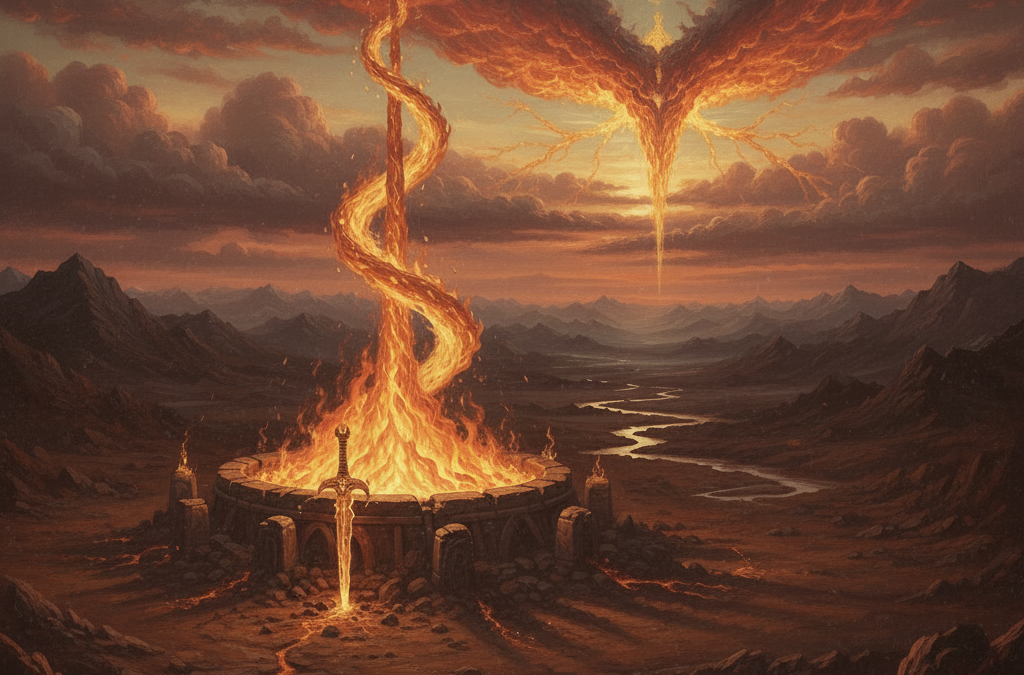
 Immediately after this exile, God brings fire into the picture when He places “the cherubim and a flaming sword that turned every way to guard the way to the tree of life.” (Genesis 3:24). The fire is not vengeance but mercy, cutting off endless life in a fallen body. Because of sin, fire now becomes necessary—not to invite humanity forward, but to restrain, guard, and hold the world in tension until redemption comes. What the sword guards is not cruelty, but the promise that restoration (and everlasting life) will come another way.
The very next scene, in Genesis 4, is a picture of how that restoration will eventually come: through a sacrifice.
Abel brings an offering from the firstborn of his flock (Genesis 4:4). Scripture does not explicitly say that fire was used, but it is a reasonable assumption. Burnt offerings become a dominant form of worship later in Scripture, and fire becomes the means by which sacrifices are transformed into smoke ascending toward God.
This is speculation, not a stated fact—but even if Abel did not use fire, it is clear that sacrifice itself is a response to sin. Fire becomes associated with atonement, loss, and substitution. Something must be destroyed so that fellowship with God can be restored.
Then comes the first unmistakable appearance of fire.
Fire as Judgment: Sodom and Gomorrah
“The Lord rained on Sodom and Gomorrah sulfur and fire from the Lord out of heaven” (Genesis 19:24, ESV).
Fire enters the biblical story unmistakably as an agent of judgment.
Sodom and Gomorrah are not refined or purified—they are obliterated. Fire and sulfur wipe them from the landscape as a response to unrepentant, systemic wickedness. Archaeological evidence suggests a location for Sodom and Gomorrah. In the Dead Sea region, researchers have found intense heat destruction, including melted pottery and high sulfur content in the soil. Fire in this supernatural story is not warmth or light; it is finality.
This pattern continues throughout Scripture. Fire consumes Nadab and Abihu for unauthorized worship (Leviticus 10:1–2). Fire falls on Elijah’s sacrifice to demonstrate the supremacy of the Lord over Baal (1 Kings 18:38). Fire accompanies God’s presence on Mount Sinai, terrifying the people below (Exodus 19:18).
Fire is powerful, holy, and dangerous.
Legends of Fire: Echoes of a Lost World
Nearly every culture has a legend about the origin of fire. This alone should catch our attention.
In Greek mythology, Prometheus steals fire from the gods and gives it to humanity, an act of rebellion that brings both progress and punishment. In Polynesian legend, Maui tricks the fire goddess to obtain fire for humans. Many Indigenous traditions speak of animals or tricksters bringing fire into the world through deception or theft.
These stories differ wildly, but they share a common thread: fire does not naturally belong to humanity. It must be taken, stolen, or earned—often at great cost.
From a biblical worldview, these myths may be distorted memories of a real theological truth: fire is not part of humanity’s original design. It enters the human story after a rupture between God and man. While these legends are not Scripture, they resonate with the Bible’s portrayal of fire as something dangerous, powerful, and tied to transgression.
Fire in Fantasy: Power and Peril
Fantasy stories seem to understand this instinctively.
In The Last Airbender, fire is the most aggressive and destructive element. Firebenders struggle with rage, control, and ambition. Fire is the element most easily corrupted—and the one most often associated with imperialism and tyranny.
In The Lord of the Rings, fire forges the Rings of Power, especially the One Ring in the fires of Mount Doom. Fire gives shape to immense evil, but only fire can unmake it.
In Harry Potter, magical fire is difficult to control, capable of destroying Horcruxes—objects literally infused with fragments of a soul. Fire becomes the only force strong enough to undo profound corruption.
Fantasy understands something Scripture has said all along: fire is never neutral.
Fire as Purification
Yet the Bible does not portray fire only as destruction.
God appears to Moses in a burning bush that is not consumed (Exodus 3:2). Fire fills the tabernacle and later the temple as a sign of God’s presence (Leviticus 9:24). Isaiah’s lips are purified by a burning coal before he is commissioned as a prophet (Isaiah 6:6–7).
Fire destroys what cannot remain—but it also refines.
This dual nature of fire mirrors God’s holiness. The same holiness that comforts and protects those who trust Him consumes those who oppose Him. As Hebrews says, “Our God is a consuming fire” (Hebrews 12:29, ESV).
When Fire Fails
One of the most striking fire stories in Scripture comes from the book of Daniel. Shadrach, Meshach, and Abednego are commanded to bow before a golden image—a false god made by human hands. They refuse, fully aware of the consequences.
Their punishment is fire.
King Nebuchadnezzar orders the furnace heated “seven times more than it was usually heated” (Daniel 3:19, ESV). The flames are so intense that the mightiest men of Babylon who throw the men inside are killed instantly. Fire, once again, appears as an unstoppable force of destruction.
And yet, something extraordinary happens.
The three men are not consumed. They are not burned. They are not even harmed. Instead, the king looks into the furnace and sees four figures walking freely in the fire. The three men thrown in the furnace are no longer bound, and “the appearance of the fourth is like a son of the gods” (Daniel 3:25).
God does not extinguish the fire.
He enters it.
When Shadrach, Meshach, and Abednego emerge, the text emphasizes the miracle in painstaking detail: “the fire had not had any power over the bodies of those men. The hair of their heads was not singed, their cloaks were not harmed, and no smell of fire had come upon them” (Daniel 3:27).
Fire, for once, is rendered powerless.
This moment offers a glimpse of what fire looks like when God stands with His people. The furnace still burns, but it no longer rules. Fire is exposed for what it truly is—an instrument, not a master.
For readers of Scripture, this scene also foreshadows something greater. Just as God walked with His faithful servants through the flames, He would one day enter a far deeper fire Himself—bearing judgment so others could pass through unharmed.
Many fantasy stories echo this moment—heroes who walk through flame unscathed, protected by a power greater than fire itself—perhaps because the image is already written into the fabric of the true story. This brings us to another important point about fire.
The Fire That Cannot Be Extinguished
Fire is powerful—but it is not sovereign.
In Genesis, fire is never left alone. It is placed within a world already ordered by God, surrounded by elements that can restrain it. Water drowns flame without effort. Earth smothers it with weight and ash. Air, the very thing fire needs to live, can also become its undoing, starving it when cut off or turning it wild until it burns itself out. Creation itself carries the means of fire’s extinction. No element is ultimate. Each depends on the others. Each has limits.
Genesis invites us to see even chemistry as ordered under God’s command; it is a world where power is distributed, restrained, and balanced under that command. Fire does not rule the waters. The waters do not rule the land. The air does not rule the flame. Only God stands above them all. What feels unstoppable to man is always stoppable to its Maker.
And yet Scripture is careful to show us a fire that cannot be put out. The burning bush is not consumed. The pillar of fire leads without destroying. The tongues of fire at Pentecost rest on human heads without devouring them. This fire does not depend on air, does not fear water, does not bow to earth. It is not sustained by nature because it does not belong to nature.
The contrast is deliberate. Created fire can be quenched by creation. God’s fire cannot. One reveals judgment and limitation. The other reveals presence. And when God’s fire burns, it does not annihilate—it orders, purifies, and sends.
The Fire to Come
The Bible’s story of fire does not end in the Old Testament.
John the Baptist declares that Jesus “will baptize you with the Holy Spirit and fire” (Matthew 3:11). At Pentecost, tongues “as of fire” rest on the disciples, marking the arrival of God’s Spirit within His people (Acts 2:3).
And at the end of the age, fire returns once more.
Peter writes that “the heavens and earth that now exist are stored up for fire” (2 Peter 3:7). Revelation describes a lake of fire representing final judgment and separation from God (Revelation 20:15). But Revelation also promises a renewed creation—a new heaven and new earth where God dwells with His people forever (Revelation 21:1–4).
Fire will either purify or destroy. In either case, it’s purpose is to destroy evil. In 1 Peter 4:12, the apostle reminds Christians that they shouldn’t be surprised by “fiery trials,” as they make us more like Christ in His suffering. But they do more than purify us, these fiery trials help us to see God more clearly—“be glad when His glory is revealed” (1 Peter 4:13). In other words, these trials make Him more visible to us. We become part of His True Fantasy.
Scripture does not treat fire lightly. It warns that the holiness which purifies the redeemed will consume what refuses redemption. But the Scriptures that warn of fire also hold out mercy. The One who walked through the furnace offers to walk with anyone who trusts Him.
The Missing Element and the Necessary Savior
Fire was missing from Eden because death had no place there. Fire entered the story because sin did. It became a symbol of judgment, sacrifice, purification, and power—never casual, never safe.
Fantasy stories sense this truth, even when they cannot name it. They treat fire with fear and reverence because fire tells a deeper story: something in the world is broken, and restoration is costly.
The Bible’s answer to that cost is not an element—it is a person.
Jesus bore judgment so that those who trust Him would not. He endured God’s wrath so that fire would refine rather than consume. The same Scriptures that warn of fire also offer rescue from it.
The Scriptures that warn of fire also reveal the One who walks through it.
The One who entered the furnace.
The One who bore judgment and came out alive.
Fire will either refine or consume — but it will not rule.
And the One who stands above it still invites us to trust Him.
Keep Reading: Chapter 6: The Heavens Declare
I can honestly say I won’t be looking at fire in the same way from now on!
Very well done,
Thank you for the insight to a question I never knew I had. : )