
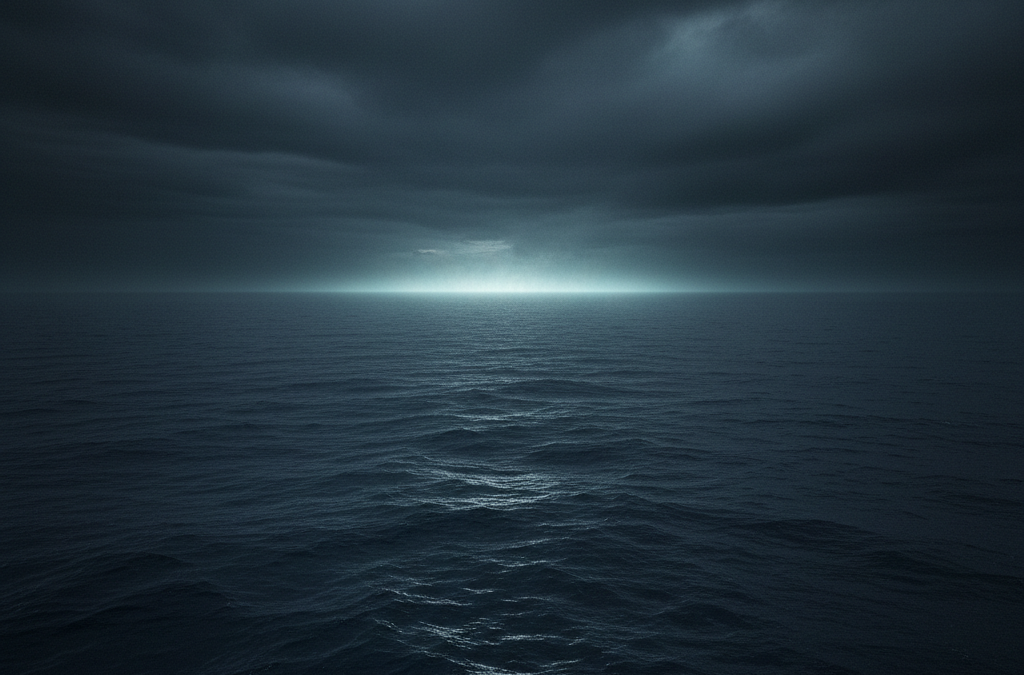
Before there was light, before there was land, before there was breath in human lungs, there was water.
Scripture does not open with stars igniting or mountains rising or gods clashing in the heavens. It begins in silence and shadow, with something ancient and unsettled stretching beneath the darkness. “Darkness was over the surface of the deep, and the Spirit of God was hovering over the waters.” In that single line, Genesis stands in radical contrast to the creation stories surrounding it.
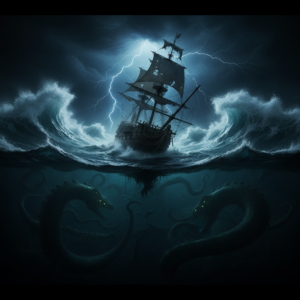 In the ancient imagination, water was never neutral. It was not scenery or symbolism. It was chaos itself—formless, dangerous, alive. The deep was where order dissolved, where certainty drowned, where human strength failed. And yet Genesis opens by calmly placing God above it. Not wrestling with the waters. Not emerging from them. Not becoming them. He hovers—unthreatened, unchallenged, sovereign. Chaos exists, but it is not ultimate.
Every pagan culture understands something true about water: it is terrifying. Seas swallow ships without apology. Rivers erase cities overnight. Storms ignore borders, prayers, and plans. Depths conceal things man cannot fight or flee. And so pagan myths make water divine, because only a god can explain chaos that vast.
In Babylonian myth, creation begins with violence as Marduk slaughters Tiamat, the sea goddess of chaos, and fashions the world from her corpse. Order is born from bloodshed, and chaos never truly dies—it merely sleeps beneath the surface.
In Norse legend, the world rises from Ginnungagap, a frozen abyss where ice and fire collide, held together by gods who will eventually fall back into the waters they escaped.
Greek mythology gives the sea a face and a temper. Poseidon is not depicted as evil, but he is volatile, drowning cities not for moral failure but for offense. Survival depends not on righteousness, but appeasement.
Even modern fantasy cannot escape this instinct. The sea is where rules loosen, and monsters wait. It is the Dead Marshes, the drowned god, the black water beneath the hero’s boat. Water is where order thins and courage is tested. Paganism is honest about chaos. It is wrong about who rules it.
Genesis does something no pagan story dares. God does not fight the waters, fear the waters, or explain the waters. He commands them.
The deep is already there when the story begins, but it is immediately framed as creation, not deity. The Spirit of God hovers—not anxiously or cautiously, but deliberately—over what cannot resist Him. Then God speaks, and chaos listens. “Let there be a vault between the waters to separate water from water.” There is no epic battle, no cosmic bloodshed, no struggle for dominance. Just a word. The waters part because God tells them to.
To the pagan mind, this is unthinkable. If chaos can be commanded, then it is not god. If water obeys, then fear loses its throne. Nature is no longer divine; it is accountable. Order does not emerge from chaos by chance. Order is imposed by God.
From that moment on, Scripture treats water as a boundary—a place where chaos presses in and God reveals who He is. The Flood is not random destruction, but a deliberate unmaking and remaking. The waters return the world to something like Genesis 1:2, and then recede again at God’s command. Judgment comes, but so does preservation. Chaos does not win; it serves.
The Miracle of Water
Water is so ordinary that we rarely stop to consider how extraordinary it is. It covers most of the earth, fills our cells, shapes our weather, and sustains every known form of life. Yet the more closely scientists study it, the more unusual it appears. Its properties defy simple explanation. It behaves in ways that seem almost carefully arranged for life to flourish.
Unlike most substances, water expands when it freezes. Ice floats. If it did not, lakes and oceans would freeze from the bottom up, and aquatic life would collapse each winter. Water also has an unusually high heat capacity, meaning it absorbs and releases heat slowly. This stabilizes climates, moderates temperatures in our bodies, and protects ecosystems from violent fluctuation. Its molecular structure allows it to dissolve an astonishing range of substances, making it the perfect medium for biological chemistry. These traits arise from the peculiar structure of water itself — and together they form a set of conditions remarkably hospitable to life. Whether one sees this as a coincidence or an intention, the effect is the same: water is astonishingly suited for life.
Researchers continue to discover new complexities in hydrogen bonding, surface tension, and water’s dynamic molecular behavior that resist reduction to simple models. It does not behave like a predictable, inert liquid. It is structured, responsive, and strangely fine‑tuned. The deeper we look, the less it feels like a generic compound and the more it appears uniquely suited for life—almost as if life was anticipated in its design.
Scripture tells us that creation declares the glory of God. Water seems to whisper that truth constantly. It cleanses. It refreshes. It sustains. It judges in the flood and delivers through the sea. It becomes the sign of new birth. The physical properties of water make life possible; its biblical symbolism makes redemption visible. Both testify to the same Author.
Water does not merely support life. It proclaims the One who gives it. In its strangeness, its beauty, and its necessity, it reminds us that the world is not self‑explaining. It is given.
When God Questions Job, the Sea Takes the Stand
Job is one of the most ancient books, but it is completely different from other ancient pagan texts. Job, as you may remember, suffers tremendously. But he never receives an explanation for his suffering. Instead, he is given a revelation of reality. When God finally speaks, He does not justify Himself. He reminds Job who commands the deep. Again and again, the sea appears—not as a metaphor, but as evidence.
God asks Job where he was “when I laid the earth’s foundation,” then immediately turns to the waters: Who shut in the sea with doors when it burst out from the womb? (Job 38). The image is striking. Chaos is not a rival power. The sea is an infant—loud, dangerous, expansive—but contained. God clothes it with clouds, wraps it in darkness, and then does something no pagan god ever claims to do: He sets limits. This far and no farther.
Later, God presses the point. Has Job ever walked in the recesses of the deep? Has he entered the storehouses of the sea? (Job 38:16). The implied answer is no. Job has never been there. God has. The depths that terrify humanity are familiar terrain to Him.
Job’s world assumed that chaos explained suffering. God flips the assumption. Chaos itself is under command. The sea does not symbolize randomness—it testifies to restraint. Waves rise because they are allowed to rise. Storms rage because they are permitted to rage. And when they stop, it is not because they are tired, but because God says enough.
In Job, the sea becomes a witness against human pretension. If Job cannot command the waters, he cannot indict the One who does. Creation itself—especially its most frightening element—stands as proof that God is not absent in disorder. He is present over it.
Job is not given answers. He is given perspective. And the moment he sees the sea as God sees it—not as sovereign chaos, but as bounded creation—his accusations dissolve. He places his hand over his mouth, not because his questions were foolish, but because the One who commands the deep has spoken.
The waters that frighten Job are the same waters Genesis begins with. And in both places, Scripture makes the same claim: chaos is real—but it has never been in charge.
When the World Forgets the Waters
Men often forget that God commands the waters, and it feels intelligent.
Peter describes it without sentiment. “Where is the promise of His coming?” they ask. “Ever since the fathers fell asleep, all things continue as they were from the beginning of creation.” The argument sounds reasonable. The sea still rises and falls. Storms come and pass. Shorelines hold. The world appears stable, self‑regulating, uninterrupted.
But Peter says something unsettling: they “deliberately forget.”
They forget that the heavens existed long ago by the word of God, and that the earth was formed out of water and through water. The ground beneath their feet once lay buried under the deep. Order emerged because God spoke. The stability they trust rests on a history of commanded chaos.
And more than that—they forget the Flood.
By those same waters, Peter says, the world of that time was deluged and destroyed. The deep that once stood restrained was released. The boundaries held—until they did not. Creation itself responded to its Author’s word. The world has already returned once to something like Genesis 1:2.
The mockers mistake continuity for independence. Because the seas remain within their limits today, they assume no One ever set those limits. But Scripture insists on the opposite. The reason chaos does not swallow us each morning is not that it lacks power. It is because it is still commanded.
Peter does not argue from speculation. He argues from memory. Creation rose from water. Judgment came through water. The present world stands suspended between them by the same Word.
To forget the waters is to forget that reality is not self‑sustaining.
And this is where True Fantasy pierces the illusion of modern certainty. Pagan myth divinized the sea because it feared it. Modernity neutralizes the sea by studying it. Both miss the point. Water is not god. It is not an accident. It is a revelation.
God has made Himself visible—not by competing with chaos, but by ruling it in history.
The Flood was not a random disaster. It was a visible judgment. The parted Red Sea was not a lucky timing. It was a visible deliverance. The restrained ocean is not a natural inevitability. It is visible patience. What Peter exposes is not merely forgetfulness of an event, but blindness to a pattern: God reveals Himself through the waters.
True Fantasy is not an escape from reality. It is seeing reality as it truly is—creation charged with meaning, history saturated with authorship. The sea does not merely threaten. It testifies. The shoreline is not just geography. It is a boundary spoken into place. Stability is not proof that God is absent. It is proof that He is merciful.
Every wave that rises and falls without consuming the earth declares the same thing Genesis did: chaos is real—but it has never been in charge.
And the One who commands it has not been silent.
God’s Power Over Water Continues
Over and over, water becomes the place where humanity must decide whether it will trust fear or authority, panic or promise.
The One who hovered over the waters in Genesis does not remain distant from them. In Jesus, Genesis is not undone — it is fulfilled.
Jesus steps into the Jordan not because He needs cleansing, but because He is reenacting the beginning of all things. Water below. Spirit above. God revealed. At His baptism, the heavens open and the Spirit descends—not hovering now, but resting. What was hinted at in Genesis is declared in full: God is present, and chaos is not in control.
From that moment on, Jesus treats water exactly as Genesis says God should. He walks on it as though chaos were solid ground beneath His feet. He speaks to storms, and they obey as if recognizing their Creator. He offers living water—not drawn from wells or seas, but flowing from Himself—life that no flood can wash away. Pagan gods demand sacrifice to survive the waters. Jesus enters the waters to save.
Even His death follows the pattern. He passes through the deepest chaos humanity knows—judgment, death, the grave—and emerges on the other side not drowned, not defeated, but victorious. Baptism itself becomes participation in that pattern: down into the waters, up into new creation. Genesis does not merely repeat. It resolves.
By the time Scripture reaches its final pages, something astonishing happens. The sea disappears. “There was no longer any sea.” Not because water was evil, but because chaos no longer has a role to play. God dwells fully with His people. There is no threat left that requires a boundary, no deep left to fear. Order is complete because God is present without distance.
What paganism feared, Christ has conquered.
Water has always asked humanity the same question: who do you trust when the ground gives way? Pagan stories answer with fear and ritual. Fantasy answers with courage and resolve. Scripture answers with surrender. To step into the water is to admit you are not sovereign, that you cannot outswim chaos or command the deep. You must trust the One who does.
And that is where water ultimately leads—not to terror, not to myth, not to nature worship, but to Christ Himself. The One who stood at the beginning above the waters. The One who stepped into them. The One who passed through death and came out alive.
The sea no longer rules the story.
It has already bowed.
Keep Reading: Chapter 5: The Missing Element