
Genesis 4 is often remembered for violence. It tells the story of Cain and Abel, and later of Lamech’s pride and revenge. Yet tucked inside this chapter is something surprising. In the middle of a world already marked by sin, culture begins to bloom.
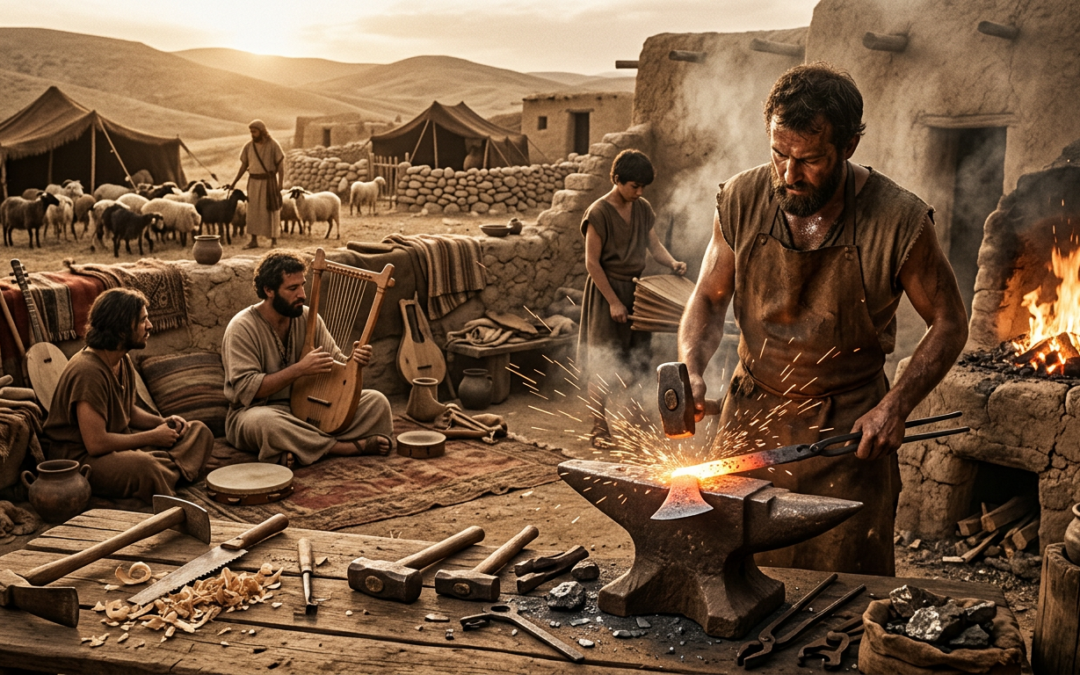
Lamech had three sons who shaped the early patterns of human life. Jabal became “the father of those who dwell in tents and have livestock.” Jubal became “the father of all those who play the lyre and pipe.” Tubal-cain forged tools out of bronze and iron. In a few short verses, Scripture shows us the beginnings of industry, music, and craftsmanship. Pastoral life, art, and metalwork all rise from the same family line.
Genesis does not treat these skills as accidents or as meaningless survival tools. Instead, it names them and remembers them. The Bible recognizes that even east of Eden, humans still build, shape, and create. Though communion with God has been strained, the image of God has not been erased. That image continues to express itself through culture.
When Tubal-cain strikes metal and shapes it into tools, he is doing more than making something useful. He is taking the raw materials of the earth and bringing order and purpose to them. When Jubal forms melody from string and breath, he is drawing beauty out of sound itself. When Jabal organizes herds and develops patterns of dwelling, he is structuring life in a way that sustains families and communities. These are not small acts. They reflect humanity’s original calling to cultivate and steward the earth.
Even in a fallen world, the Creator’s echo can still be heard. Every hammer strike, every carved beam, every woven tune carries forward the memory of God’s first command over the void: “Let there be.” Human creativity is never merely functional. It answers something deep within us, a desire to shape, to order, to make beauty and meaning from what we are given.
Yet these same skills can also be turned against the One who gave them. Metal shaped for tools can just as easily be shaped for weapons (which can be wielded for good or evil). Music meant to express beauty can stir pride or glorify violence. Industry meant to sustain families can be driven by greed or power. When craft is severed from reverence for the Creator, it no longer echoes “Let there be”; it begins to echo Lamech’s boast. And when culture is fueled by pride instead of gratitude, destruction is never far behind.
At the same time, Genesis 4 reminds us that culture grows in the same soil as pride. The arts and crafts emerge alongside boasting and violence. This tension runs through the whole Bible. Skill and creativity are real gifts, yet they must be guided by humility and worship. The problem is not the workshop or the studio. The problem is the human heart.
The Bible’s larger story does not reject craft or art. Instead, it gathers them up. Later, God will fill craftsmen with His Spirit to build the tabernacle. Music will fill the temple. The work of human hands will become part of worship. Genesis 4 shows us the beginning: even outside the garden, humans still create. Culture begins not as rebellion against God, but as a lingering reflection of Him.